

The Chemistry Behind Polyolefin (PO) Hot Melt Adhesives
When you are looking for a high-performance thermoplastic bonding agent, understanding the backbone of the product helps you make the right choice for your assembly line. Polyolefin hot melt adhesive relies on a clean, highly stable hydrocarbon chemistry that outperforms traditional glues. By building these adhesives from the ground up, we ensure maximum bonding power and thermal stability for your production needs.
Hydrocarbon Polymer Chains
The foundation of any quality polyolefin adhesive lies in its specific hydrocarbon polymer chains. We utilize three primary building blocks to fine-tune our formulas:
- Ethylene: Provides structural strength and robust cohesive toughness.
- Propylene: Delivers excellent heat resistance and balanced open times.
- Butene: Enhances flexibility, particularly in low-temperature environments.
By precisely manipulating these chains, we create a reliable PO hot melt adhesive tailored for tough packaging carton sealing and demanding industrial assembly.
APAO vs. Metallocene Polyolefin
We categorize our polyolefin adhesives into two distinct varieties, depending on your specific application needs:
| Adhesive Type | Core Characteristics | Best Used For |
|---|---|---|
| Amorphous Poly-Alpha-Olefin (APAO) | Long open times, high tack, exceptional flexibility. | Large surface lamination, automotive trim, foam bonding. |
| Metallocene Polyolefin | Narrow molecular weight distribution, crisp setting speeds, extreme purity. | High-speed automated packaging, low VOC emissions, clean cutoff. |
The Additive Matrix
The raw polymer chain provides the structure, but our precise additive matrix delivers the actual performance. We blend specific components to maximize efficiency on your factory floor:
- Tackifiers: Improve initial wet-out and substrate compatibility, especially on low-energy surfaces like PP and PE.
- Stabilizing Waxes: Control the viscosity and setting speed, ensuring clean application without stringing.
- Antioxidants: Provide essential pot life extension and adhesive charring reduction, keeping your nozzles clean and reducing machine maintenance.
Polyolefin vs. EVA: The Ultimate Performance Comparison
When evaluating thermoplastic bonding agents for high-volume production, the choice usually comes down to traditional Ethylene-Vinyl Acetate (EVA) or advanced polyolefin hot melt adhesive. While EVA has been the industry workhorse for decades, PO hot melt adhesive represents a massive step forward in chemical stability and mileage.
If you are currently using EVA and trying to decide if making the switch makes sense for your lines, understanding how these two polymers handle heat, density, and extreme environments will clarify your ROI. You can dive deeper into the fundamentals of the older standard in our guide to what is EVA hot melt adhesive, but here is how they stack up head-to-head.
Thermal Stability and Pot Life
The most significant operational difference between these two technologies is how they behave inside your pre-melters.
- EVA Degradation: EVA adhesives are prone to thermal cracking. When left at application temperatures, the vinyl acetate links break down, leading to adhesive charring, skinning, viscosity changes, and clogged nozzles.
- Polyolefin Resistance: Built on a pure hydrocarbon backbone, polyolefins offer exceptional thermal stability. They resist oxidative degradation even when held at high temperatures for days. This massive pot life extension means zero char, stable viscosity, and a dramatic drop in your scheduled maintenance downtime.
Density and Yield Advantages
Many plant managers look only at the price per pound, missing the hidden economic advantage of polyolefin chemistry.
- Lower Specific Gravity: PO adhesives have a significantly lower density (around 0.89 to 0.92 g/cm³) compared to EVA (typically 0.96 to 0.98 g/cm³).
- The Mileage Bonus: Because the material is less dense, you use less physical weight of adhesive to achieve the exact same bead volume. Switching to polyolefin automatically delivers a density and yield advantage, giving you up to 15% to 20% more adhesive volume per pound.
Temperature Ranges & Environmental Tolerance
United States logistics corridors demand packaging that survives both desert heat waves and deep-freeze supply chains.
- Deep-Freeze Performance: Traditional EVAs get brittle around freezing, risking pop-opens in refrigerated transport. Metallocene polyolefins maintain excellent cold flexibility performance, holding strong down to -40°F.
- High-Heat Boundaries: On the upper end, PO formulations resist lifting and shearing at temperatures well above 140°F, ensuring structural integrity during hot summer transit.
Technical Comparison Matrix
For a quick, data-driven look at how these materials perform side-by-side on the factory floor, reference our technical baseline below:
| Performance Metric | EVA Adhesives | Polyolefin (PO) Adhesives |
|---|---|---|
| Thermal Stability | Moderate (Prone to charring & skinning) | Exceptional (Zero char, viscosity stability) |
| Average Density | ~0.96 – 0.98 g/cm³ | ~0.89 – 0.92 g/cm³ (Higher yield per lb) |
| Cold Flexibility | Poor to Fair (Becomes brittle) | Excellent (Down to -40°F) |
| Heat Resistance | Moderate (Risk of softening in transit) | High (Maintains bond integrity) |
| Equipment Wear | High (Nozzle clogs from char) | Extremely Low (Clean running) |
| Odor & Emissions | Noticeable acetic acid odor | Low VOC emissions (Nearly odorless) |
Choosing the right polymer profile directly affects your line speed and total cost of ownership. If you need a broader overview of how to match these properties to your specific equipment setup, check out our resource on how to choose the right hot melt adhesive.
Core Advantages of Choosing Polyolefin Adhesives
When upgrading your production line, choosing the right polyolefin hot melt adhesive can completely transform your operational efficiency. Polyolefin (PO) formulations bring specific engineering benefits that directly solve everyday manufacturing headaches on the plant floor.
1. Superior Adhesion to Low-Energy Surfaces
Bonding difficult substrates like polypropylene (PP), polyethylene (PE), and heavily coated high-gloss corrugated boxes can be a nightmare for standard glues. Our PO hot melt adhesives feature exceptional substrate compatibility, biting into these tricky, low-energy surfaces without requiring expensive surface pre-treatments.
2. Exceptional Thermal Stability
Unlike traditional adhesives that degrade when left in a hot tank, polyolefin-based options offer unmatched viscosity stability.
- No Charring: Virtually eliminates gel formation and nozzle plugging.
- Pot Life Extension: Maintenance teams spend less time scraping out charred tanks, significantly reducing unexpected downtime.
3. Reduced Application Weights
Because polyolefin has a lower density compared to traditional options, you get a much higher volume of glue per pound.
- More mileage: You use less adhesive by weight per bond.
- Cost savings: A thinner bead achieves the same structural bond strength, cutting overall material consumption.
4. Improved Factory Floor Environment
Worker safety and comfort matter. Our polyolefin adhesives offer an incredibly clean run with low VOC emissions and zero harsh odors. A cleaner burn means fewer fumes, creating a healthier, more pleasant breathing environment for your operators.
5. Sustainability and Circular Economy Compatibility
As US manufacturing shifts toward green initiatives, polyolefin stands out among other types of hot melt adhesives. Because it is a pure hydrocarbon polymer, it easily integrates into recycling streams without contaminating the cardboard pulping process, supporting your facility’s zero-waste and circular economy goals.
When Should You Use Polyolefin Hot Melt Adhesives?
Choosing the right thermoplastic bonding agents can make or break your production efficiency. While traditional options work for basic applications, switching to a polyolefin hot melt adhesive becomes necessary when your operations face demanding environments. Here are the key drivers that dictate when you should make the switch.
High-Speed Packaging Lines
Modern packaging carton sealing demands rapid set times. PO hot melt adhesive formulas are engineered for high-output environments, delivering ultra-fast compression cycles. The adhesive sets almost instantly upon contact, eliminating popped flaps and keeping high-speed machinery running at maximum capacity without bottlenecking the line.
Extreme Thermal Conditions during Logistics
If your goods endure unpredictable shipping environments, standard glues will fail. Polyolefin adhesives offer an exceptional temperature range that protects your bonds from thermal shock.
- Deep-Freeze Resistance: Maintains cold flexibility performance down to -40°F without becoming brittle or cracking.
- High-Heat Stability: Resists softening or releasing in unconditioned shipping containers that reach up to 160°F during summer transit.
Challenging Substrates & Coated Boards
Recycled corrugated cardboard, wax-coated boards, and high-density plastics are notoriously difficult to bond. Polyolefin adhesive uses its unique chemical structure to bite into these low-energy surfaces. It provides deep fiber tear on heavily treated or recycled paper stocks where an EVA hot melt adhesive would simply peel away.
Maintenance Cost Reduction Goals
If your team spends too much time cleaning char out of your glue pots, it is time to upgrade. Polyolefin offers superior thermal stability, which means it can sit at application temperatures for days without degrading.
The Maintenance Payoff: Switching to polyolefin results in a drastic adhesive charring reduction, fewer clogged nozzles, extended pot life, and a significant drop in unplanned machine downtime.
Primary Industry Applications for Polyolefin Adhesive
Polyolefin hot melt adhesive delivers exceptional bonding performance across diverse manufacturing sectors. Our high-purity formulations are designed to handle demanding assembly lines, extreme temperatures, and challenging substrates.
Here is how different industries utilize PO hot melt adhesive to optimize their production lines:
1. End-of-Line Packaging & Food Logistics
In the United States, fast-moving consumer goods rely on high-speed packaging carton sealing. Polyolefin adhesives provide the rapid set times required for automated lines. They maintain bond integrity from deep-freeze storage up to hot shipping containers, preventing pop-opens during transit.
2. Automotive Assembly & Interior Trim
Automotive manufacturing requires lightweight materials and low VOC emissions. Polyolefin thermoplastic bonding agents securely bond interior carpets, door panels, and headliners. Their high heat resistance ensures interior components do not detach under intense summer sun exposure.
3. Woodworking and Edge Banding
Furniture manufacturers use polyolefin for seamless edge banding on cabinetry and desks. It offers a tighter, cleaner bond line compared to traditional options, protecting wood substrates from moisture penetration and heat degradation.
4. Technical Textiles & Nonwovens
In hygienic and medical product manufacturing, polyolefin ensures soft, flexible, and odorless bonds. It securely laminates nonwoven layers together without stiffening the fabric, maintaining the comfort and integrity of the final product.
Industry Application Matrix
| Industry | Primary Use Case | Key Substrates | Main Benefit |
|---|---|---|---|
| Packaging | Case & carton sealing, tray forming | Coated board, recycled cardboard | Zero charring, deep-freeze resistance |
| Automotive | Interior trim, headliners, acoustic foam | PP, ABS, fiberglass, fabrics | Low VOCs, high heat threshold |
| Woodworking | Edge banding, profile wrapping | MDF, particleboard, PVC, veneer | Invisible bond lines, moisture barrier |
| Textiles | Nonwoven lamination, hygiene products | PE film, polypropylene webs | Odorless, flexible bonding |
For manufacturers looking to upgrade their assembly efficiency, exploring our advanced industrial products helps identify the exact open times and setting speeds needed for your specific machinery setup.
Troubleshooting and Best Practices for Implementation
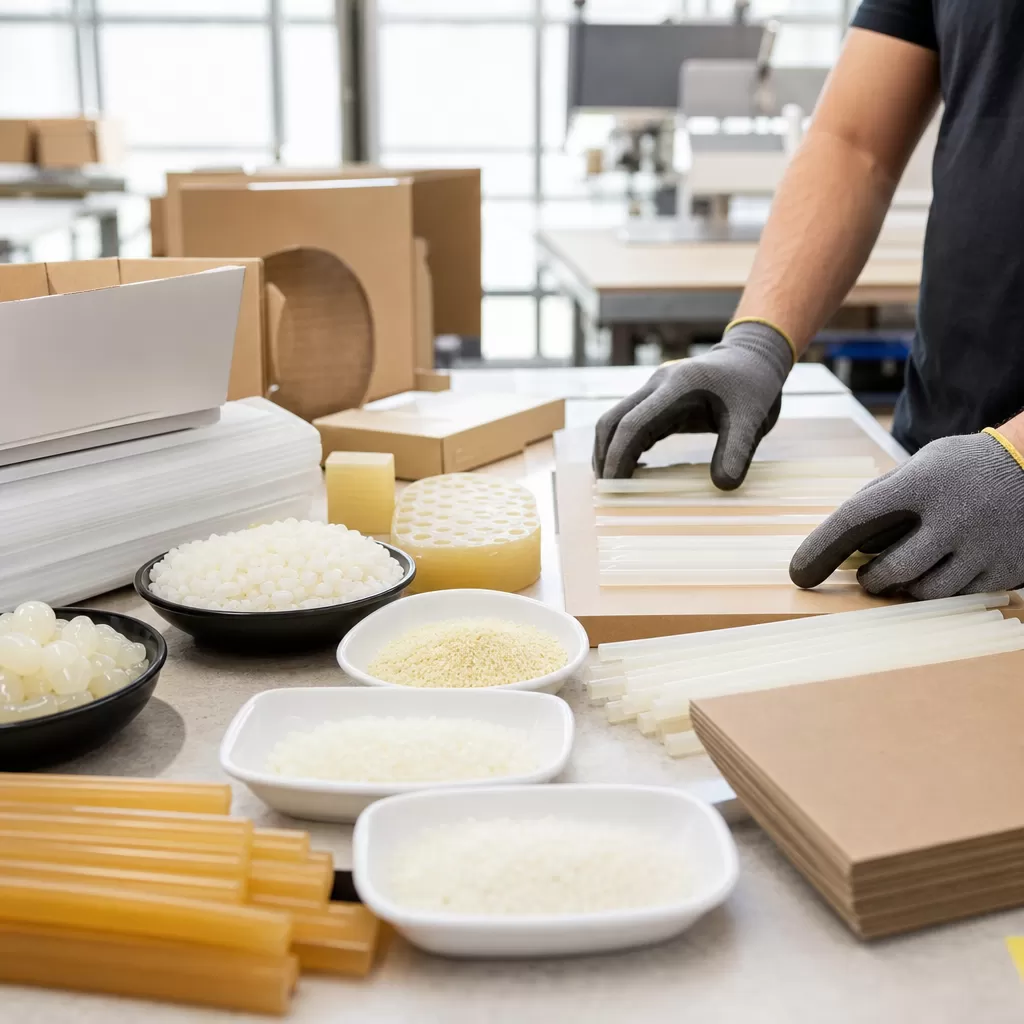
Getting the most out of polyolefin hot melt adhesive requires precise application settings and a solid understanding of your machinery. While transitioning to a PO hot melt adhesive vastly improves line efficiency, skipping proper setup steps can lead to inconsistent bonding.
Optimal Temperature Windows
Maintaining the correct operating temperature is critical for ensuring the proper viscosity and open time of your adhesive.
- Standard Operating Range: Most polyolefin formulations perform best between 350°F and 375°F (177°C to 190°C).
- Heat Management: Avoid overheating the material. While polyolefin offers exceptional thermal stability compared to EVA, running your tanks too hot for extended periods can still degrade the polymer chains over time.
- Low-Temperature Formulations: Some specialized lines run as low as 275°F (135°C) to protect heat-sensitive substrates and reduce energy consumption. Always verify the technical data sheet for your specific grade.
Transitioning from EVA to PO
Switching your production line from a traditional ethylene-vinyl acetate (EVA) alternative to a metallocene polyolefin requires a thorough system purge to prevent cross-contamination.
- Drain the System: Empty the melt tank, hoses, and applicator guns completely while the system is still warm.
- Flush the Equipment: Use a dedicated paraffin-based purging compound to push out remaining EVA residue. EVA and PO have different chemical structures, and mixing them can cause gelling or clogged nozzles.
- Change the Filters: Replace all inline filters before charging the system with the new polyolefin adhesive.
- Calibrate Pressure and Feed Rates: Because polyolefin has a lower density and different flow characteristics, you may need to back off the pump pressure to achieve the same precise bead weight.
Equipment Compatibility
Polyolefin adhesives run beautifully on almost all standard hot melt equipment, but a few hardware checks keep the floor running smoothly.
| Component | Compatibility Requirement | Optimizing for Polyolefin |
|---|---|---|
| Tank Filters | Standard mesh | Check and clean during the initial 48 hours after a retrofitted switch. |
| Nozzle Orifices | 0.012 to 0.020 inches | Smaller diameters work well due to the clean cutoff and anti-stringing properties of PO. |
| Hose Heating | Integrated zone control | Ensure uniform heating along the entire hose length to prevent cold spots and viscosity spikes. |
Pro Tip: If you notice skipped beads or irregular patterns, check the nozzle seals. Polyolefin’s clean-running nature reduces adhesive charring, so ongoing clogging usually points to leftover EVA residue rather than the new adhesive. For more operational insights on upgrading your production line adhesive setups, check out our comprehensive manufacturer’s guide to industrial adhesives.
How KAISUN Transforms Your Production Efficiency
We engineer our high-purity polyolefin hot melt adhesive lines to solve the exact floor challenges American manufacturers face every day: line downtime, adhesive charring, and inconsistent bond strength. By shifting to our advanced formulations, facilities notice an immediate drop in maintenance costs and a major spike in daily output.
Our PO hot melt adhesive catalog is built for adaptability, offering specific formulations designed for your unique line speeds and substrate challenges.
Tailored Industrial Solutions
| Product Series | Open Time | Setting Speed | Best Used For |
|---|---|---|---|
| KAISUN Express | Very Short (1-2 sec) | Ultra-Fast | High-speed automated packaging, carton sealing |
| KAISUN Flex | Medium (15-30 sec) | Moderate | Precision automotive trim, complex product assembly |
| KAISUN Extended | Long (60+ sec) | Slow | Large-surface woodworking, manual edge banding |
Our Engineering Advantage
We don’t just ship boxes of adhesive; we deliver turnkey production upgrades. We know that switching to a new polyolefin adhesive requires precision, which is why our engineering team provides direct technical support for seamless facility trials. We assist your team with onsite integration, dial in the exact application temperatures, and optimize your nozzle outputs. Whether we are optimizing a high-speed packaging line or preparing for regional manufacturing exhibitions like Interzum Guangzhou, our focus remains on maximizing your operational efficiency and reducing total adhesive waste.
FAQs About Polyolefin Hot Melt Adhesives
What is the difference between PO and EVA adhesives?
The primary difference lies in thermal stability and overall mileage. PO hot melt adhesive features a clean, stable formulation that resists charring, gelling, and nozzle clogging far better than Ethylene-vinyl acetate (EVA) alternatives. While EVA is a traditional, budget-friendly option, it breaks down quickly under prolonged heat. Polyolefin options also have a lower density, meaning you use less adhesive weight per squeeze to achieve a stronger, more reliable bond.
Can polyolefin adhesive be used on plastics like PP and PE?
Yes, this is where polyolefin adhesive uses truly shine. Plastics like polypropylene (PP) and polyethylene (PE) are low-energy surfaces that notoriously reject standard glues. Because polyolefin shares a similar chemical backbone with these olefins, it creates an exceptional bond with untreated PP and PE, making it a go-to choice for automotive trim, product assembly, and specialized packaging.
What is the ideal application temperature for PO hot melt?
The ideal application temperature for most thermoplastic bonding agents ranges between 320°F and 375°F (160°C to 190°C). Running within this window ensures the perfect balance of viscosity stability, open time, and fast setting speed. Maintaining the correct temperature eliminates equipment wear and maximizes your line efficiency. For those looking to optimize their overall production setup, reviewing our insights on uncategorized industrial applications can provide additional guidance on equipment tuning and adhesive integration.


