
EVA hot melt adhesive is a thermoplastic adhesive based on ethylene-vinyl acetate copolymer. It is applied molten and develops a bond as it cools. A typical formulation combines EVA for the polymer framework, tackifying resin to adjust wetting and tack, wax and/or plasticizer to modify flow and setting behavior, and antioxidants to slow oxidative degradation. Performance depends on the complete grade, the substrates, processing conditions and the finished product’s environment.
For industrial buyers, the useful question is which EVA grade will wet the actual surfaces, stay workable until assembly, and develop enough strength before compression ends. Neither the EVA name nor a single data-sheet value answers all three.
Need help shortlisting a grade? Send KAISUN your substrate pair, application method and line speed to request an EVA recommendation and the relevant technical data sheet.

What Is EVA Hot Melt Adhesive, and How Does It Work?
EVA stands for ethylene-vinyl acetate. In conventional EVA hot melt adhesives, this copolymer forms part of a formulated blend designed for a particular bonding process.
The adhesive is heated, deposited onto a surface, and brought into contact with the mating material while it can still wet that surface. Cooling then builds the strength needed to hold the assembly together. Conventional EVA hot melts do not require moisture curing, and reheating can soften the bond.
This makes suitable grades candidates for carton sealing, paper converting, bookbinding, edge banding and selected product assembly. It also means that heat exposure under load needs evaluation on the finished joint.
Explore our EVA hot melt adhesive product range when you are ready to compare application-specific options.
EVA Hot Melt Adhesive Formulation: What Each Ingredient Does
An EVA hot melt adhesive formulation balances adhesion, cohesion, flow, flexibility and setting behavior. Ingredient names explain the design approach; they do not establish a finished adhesive’s suitability on their own. The following explains ingredient functions without providing commercial formulation ratios.
| Component | Main function | What the result depends on |
|---|---|---|
| EVA copolymer | Provides the polymer framework and contributes to cohesion, flexibility and melt behavior | Copolymer grade, vinyl acetate content, molecular characteristics and compatibility with the rest of the blend |
| Tackifying resin | Adjusts wetting, tack and adhesion behavior | Resin chemistry, compatibility, softening behavior and the actual substrate surface |
| Wax | Modifies melt viscosity and crystallization/setting behavior | Wax type and its interaction with the polymer and resin; faster setting can reduce the available assembly window |
| Plasticizer, where used | Adjusts flexibility and flow | Compatibility and the balance between softness, cohesive strength, migration and heat-creep performance |
| Antioxidants and stabilizers | Help slow oxidative degradation during manufacture and hot holding | Stabilizer system, temperature, oxygen exposure, residence time and contamination |
EVA Copolymer: More Than Vinyl Acetate Content
Vinyl acetate content influences polarity and crystallinity, but it is not a stand-alone predictor of bond strength, open time or cold performance. Molecular characteristics and the other formulation ingredients also affect the result.
Two adhesives based on EVA can therefore behave differently on the same production line. Approve the finished grade through its documentation and bond tests rather than selecting by polymer composition alone.
Tackifiers: Balance Wetting and Cohesion
Tackifying resins help tune the adhesive’s contact with the substrate and its tack behavior. Their effect depends on compatibility with the EVA and the rest of the blend. Increasing tackifier content does not automatically increase final strength or improve adhesion to every plastic.
Coated board, printed surfaces and low-surface-energy plastics should be tested as supplied for production, including relevant treatments and primers.
Waxes and Plasticizers: Different Ways to Adjust Processing
Waxes can change flow and how the adhesive solidifies. Plasticizers, when included, can modify flexibility and viscosity. They are not interchangeable, and not every EVA formulation needs both.
A change that improves dispensing or flexibility may also change open time, early holding strength or resistance to movement under heat and load. Buyers should specify the performance needed rather than request a particular additive as a universal solution.
Antioxidants: Slower Degradation, Not a No-Char Guarantee
Antioxidants help delay oxidative degradation. They do not make an adhesive immune to overheating, repeated heating, excessive hot holding or contamination.
Evaluate thermal stability under an agreed temperature and holding period. Depending on the application, useful observations include viscosity change, discoloration, skin or gel formation, and deposits. A clean-looking sample alone does not prove unchanged bonding performance.
EVA Adhesive Properties: How to Read a Grade-Specific TDS
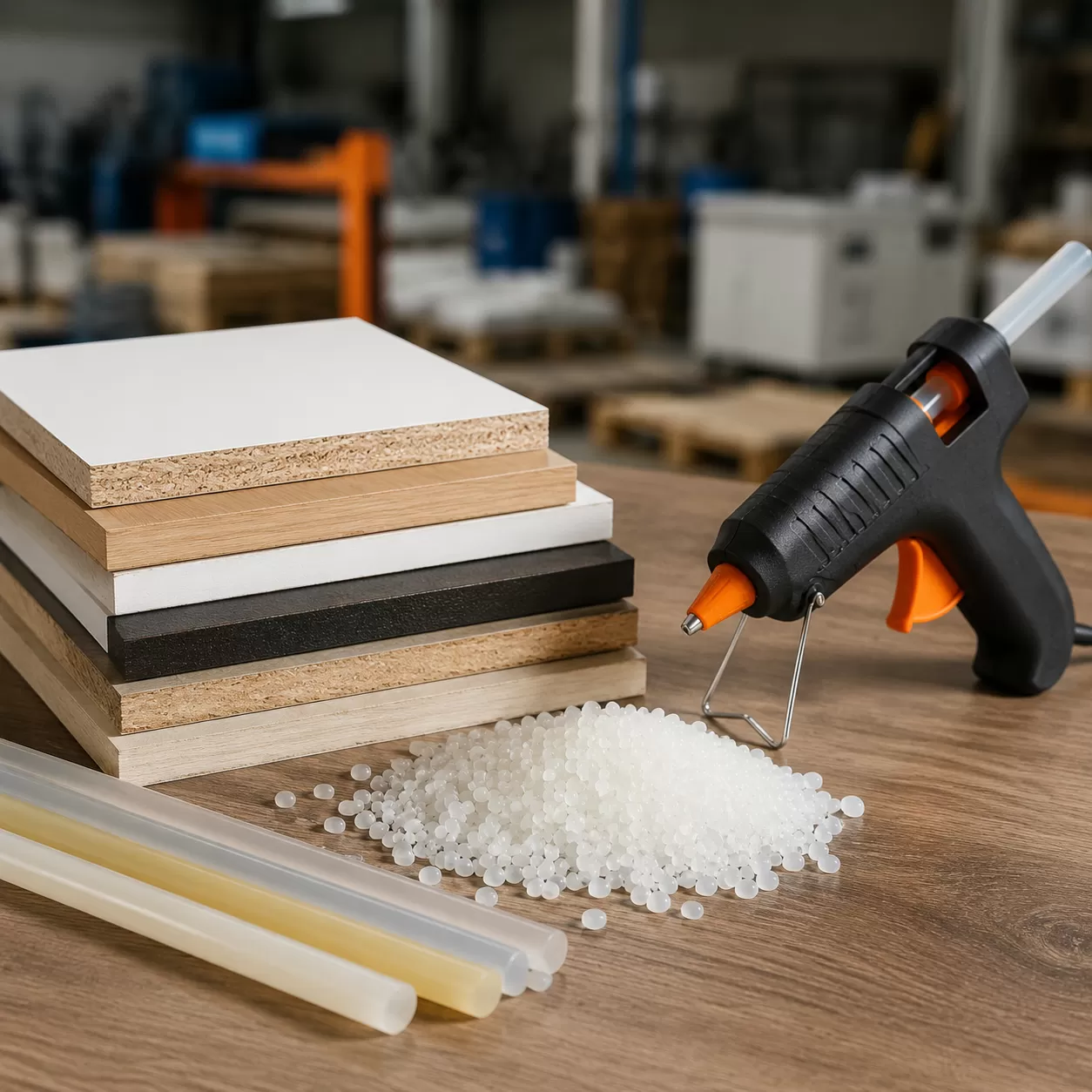
There is no single viscosity, open time, set time or application temperature that describes all EVA hot melts. Use the technical data sheet for the proposed grade and request the test conditions behind important values.
The entries below are fictional TDS reading examples. They are not KAISUN product specifications, recommended machine settings or universal EVA ranges.
| TDS item | Illustrative entry for a hypothetical grade | How to interpret it |
|---|---|---|
| Melt viscosity | 2,400 mPa·s at 160°C, typical | The temperature is part of the result. Obtain the test method and relevant instrument settings before comparing grades. |
| Application temperature | 150–170°C, supplier-recommended window | This hypothetical window belongs only to this example. Use the actual grade’s instructions and confirm tank, hose and applicator conditions. |
| Open time | 8 seconds under the supplier’s stated test | Check substrates, deposit size, temperatures and assembly procedure; your usable assembly window may differ. |
| Set time | 3 seconds to a defined handling endpoint | Ask what strength or resistance to movement defined the endpoint and how compression was applied. |
| Softening point | 100°C, ring-and-ball method | A material test value, not permission to use the finished bond at 100°C. |
| Thermal stability | Results after an agreed hot-hold test | Request the temperature, duration, exposure conditions and measured changes. |
Match Viscosity to the Dispensing Process
A viscosity number without a temperature is incomplete. Compare results under matched conditions and confirm that the adhesive can be delivered consistently through the intended nozzle, roller or coating head.
Lower viscosity is not automatically better for a fast line. Excessive penetration or uncontrolled flow can reduce the useful adhesive remaining at the interface. Higher viscosity may affect wetting and equipment pressure. The objective is a controlled deposit and reliable contact with both surfaces.
Separate Open Time from Set Time
Open time concerns how long the deposited adhesive remains suitable for joining. Set time concerns development of enough strength to resist a defined movement or load.
For a carton line, the adhesive must remain workable until the flap closes and develop adequate holding strength before the carton leaves compression. Bead size, substrate temperature, assembly delay and compression all affect this balance.
Separate Softening Point from Service Performance
A softening-point result cannot establish the maximum operating temperature of a bonded product. Joint geometry, load, exposure time and substrate adhesion must also be considered. See our hot melt adhesive softening point guide for this distinction.
Also distinguish a typical TDS value from an agreed acceptance limit and a batch result. Our TDS, SDS and COA guide explains how these documents support different purchasing checks.
Comparing two EVA grades? Send their TDS documents and your process conditions to request a grade review and discuss a sample trial on your materials.
Industrial Applications: Match the EVA Grade to the Bonding Task
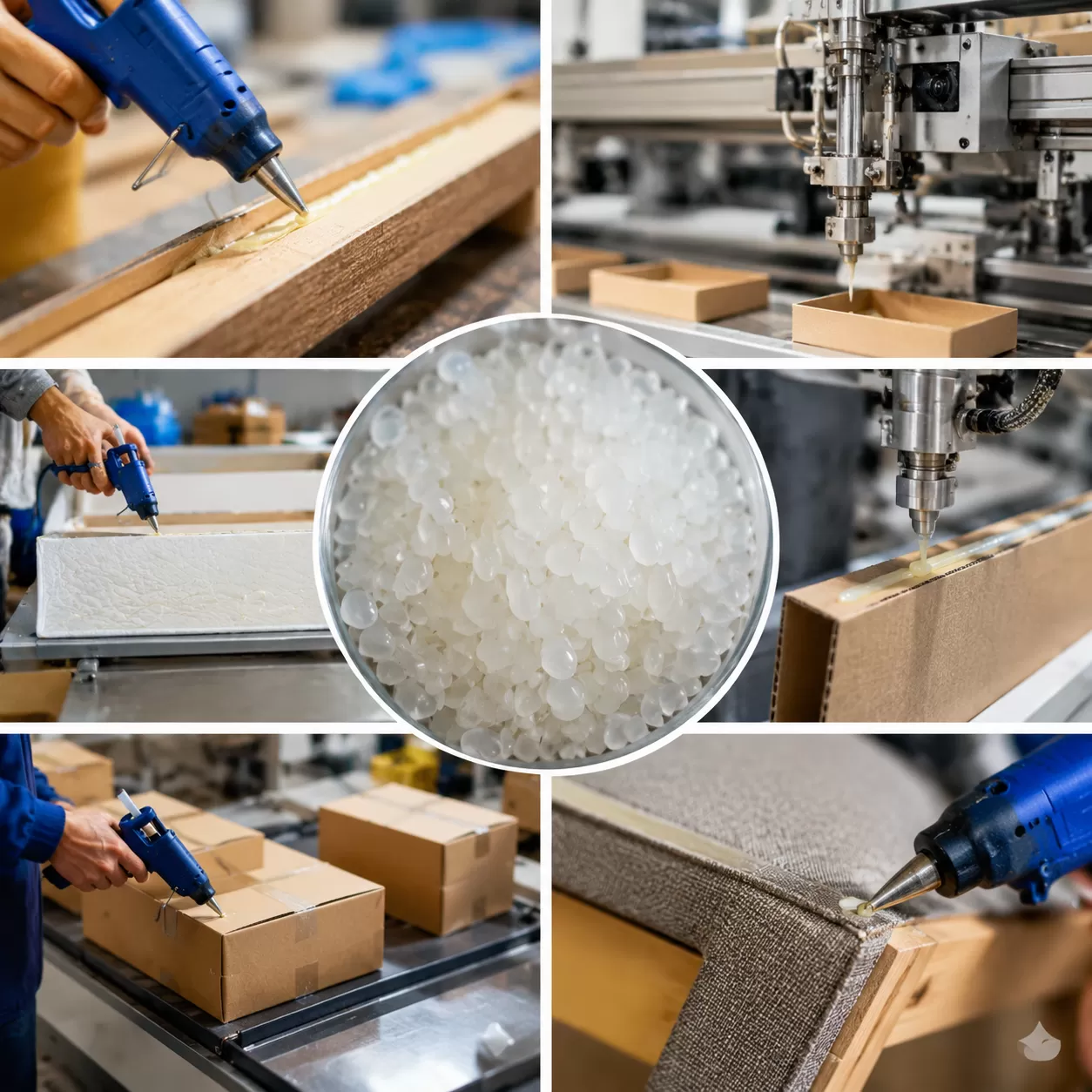
An application category is a starting point for selection. A packaging grade should not automatically be transferred to bookbinding or edge banding.
| Industrial application | Main selection priorities | What to verify before approval |
|---|---|---|
| Corrugated case and folding-carton sealing | Wetting, assembly window and holding strength before compression release | Actual board, coatings, flap recovery, bead placement and performance after transport/storage conditioning |
| Paper converting and tray forming | Controlled deposit, setting behavior and surface compatibility | Coated or recycled stock, appearance and bond consistency at production speed |
| Bookbinding | Spine flexibility, paper compatibility and page retention | Actual paper stock, spine preparation, page-pull/flex testing and intended storage conditions |
| Furniture edge banding | Equipment compatibility, wetting and early strength | Board quality, edge material and primer, joint appearance and durability after relevant conditioning |
| Selected textile lamination and product assembly | Material compatibility, flexibility and controlled application | Heat sensitivity, adhesive penetration, peel strength and aging on the complete assembly |
For bookbinding decisions, use the dedicated PUR vs EVA for bookbinding comparison. For edge-banding processes where a reactive option is being evaluated, review our PUR edge banding adhesive guide.
Automotive or other demanding technical assemblies need application-specific qualification. A general EVA description does not establish heat-aging, emissions, flammability or long-term durability performance.
When to Compare EVA with Another Adhesive Chemistry
EVA can be a practical candidate where a suitable grade gives the required bond and handling performance on compatible equipment. Its suitability becomes less certain when the joint must tolerate sustained heat and load, difficult surfaces or demanding environmental exposure.
Compare candidate grades on the same substrates and against the same acceptance criteria. Conventional EVA sets by cooling; reactive PUR additionally develops its cured structure through moisture reaction. That mechanism difference matters, but neither chemistry name guarantees success on a particular joint.
Keep detailed chemistry comparisons in our PUR vs EVA hot melt adhesive guide. If several adhesive families are still under consideration, start with the types of hot melt adhesives overview.
How to Select and Validate an EVA Hot Melt Adhesive
1. Define the Actual Bond
Identify both surfaces, including coatings, primers, treatments and variations between material suppliers. State whether the joint will experience peel, shear, flap spring-back or another load.
2. Record the Production Conditions
Provide the application method, equipment model, current temperatures, line speed, assembly delay and compression time. Include bead dimensions or coat weight where available. These details make an initial grade recommendation more useful.
3. Review the Grade Documents
Request the current TDS and SDS, then agree which properties require batch control. Confirm product form and feeding compatibility, storage requirements and the available shelf life. Solvent-free processing does not remove hot-material handling requirements; follow the grade’s SDS and equipment instructions.
4. Compare Samples Under Controlled Conditions
Keep substrates, adhesive quantity, assembly timing and compression consistent when comparing samples. Record any necessary grade-specific processing differences. Test initial handling and the bond after relevant heat, cold, moisture or aging exposure.
Set the acceptance criteria before testing. For packaging, these may include resistance to reopening and an agreed failure mode after conditioning. For bookbinding or lamination, use the appropriate strength and flexibility checks for the finished product.
5. Run a Production Trial Before Bulk Approval
A short bench test cannot show every effect of longer hot holding, line stops or repeated starts. During the production trial, record bond failures, deposit consistency, stringing, deposits, adhesive consumption and cleaning requirements.
Compare the cost per accepted finished unit. A lower price per kilogram is only useful if consumption, rejects and downtime remain acceptable.
For shipment documentation and HS classification, use our existing guide to importing hot melt adhesive from China. Have the classification checked for the actual goods and destination; the name “EVA hot melt adhesive” alone does not establish the correct code.
Frequently Asked Questions
Is EVA Resin the Same as EVA Hot Melt Adhesive?
No. EVA resin is a polymer raw material. A finished EVA hot melt adhesive is generally a formulated blend with ingredients chosen to adjust processing and bonding performance. A raw-resin data sheet cannot replace the finished adhesive’s TDS.
Is There One Standard EVA Hot Melt Adhesive Formulation?
No. Different applications need different balances of flow, wetting, open time, setting behavior and cohesion. Ingredient functions help explain those differences, but buyers should approve a grade using its documents and application tests rather than a generic recipe.
What Application Temperature Should I Use?
Use the selected grade’s recommended processing window and verify actual equipment temperatures. A viscosity measurement temperature or a softening-point value is not automatically a recommended operating setting.
Do Antioxidants Prevent EVA Hot Melt from Charring?
They help slow oxidative degradation but cannot guarantee char-free operation. Temperature, hot-hold duration, oxygen exposure, contamination and equipment condition still matter.
Is EVA Hot Melt Adhesive Waterproof or Suitable for Every Plastic?
Neither claim can be made for the entire adhesive family. Test the actual joint under its expected moisture exposure. For plastics, identify the specific material and surface condition; coatings, treatments and low surface energy can materially affect adhesion.
How Can I Choose Between Two EVA Grades with Similar TDS Values?
First check that the values use comparable methods and conditions. Then compare both grades on your substrates and equipment. Similar viscosity or softening-point values do not establish equal adhesion, setting behavior or durability.
Request an EVA Grade Recommendation, TDS and Sample Trial
Send the following details so the recommendation and quotation can address your production requirements:
| Information to send | Details that help |
|---|---|
| Bonding task | Finished product and the function of the joint |
| Substrates | Both materials, coatings or primers, plus photographs or samples |
| Equipment and process | Machine model, application method, temperatures, line speed, assembly delay and compression |
| Current adhesive or problem | Grade/TDS if available, and the failure or improvement target |
| Service conditions | Heat, cold, moisture, loading, transport and storage requirements |
| Purchasing needs | Trial quantity, expected consumption, delivery destination and required documents |
Contact KAISUN to request an EVA hot melt adhesive recommendation, the relevant TDS, and sample and quotation details. Include your substrate pair and current process first, even if the remaining information is still being collected.


