

Choose hot melt PSA for labels and tapes by comparing named grades on the same finished construction under matched conditions. Check initial tack, peel adhesion, sustained holding power, converting behavior and performance after the expected environmental exposure. A ring-and-ball softening point cannot guarantee summer transport or freezer performance. The finished label or tape bond still needs environmental and load testing.
For purchasing, define the face stock or backing, release liner, target surface, coat weight and use conditions before requesting a recommendation from the PSA hot melt adhesive range. These details make supplier quotations and sample results more useful than a general request for a stronger or stickier adhesive.
What hot melt PSA means for label and tape buyers
A hot melt pressure-sensitive adhesive is coated in a heated, flowable state and remains pressure sensitive after cooling. The converter applies molten adhesive to a backing or liner; the customer later applies the finished label or tape with pressure. These are separate operations with different temperature requirements.
Many conventional HMPSAs use styrenic block copolymers with tackifying resins, oils or plasticizers and stabilizers. The formulation affects wetting, cohesion and processing behavior. Changing one ingredient can alter several properties, so a higher tack result alone does not establish a better grade.
The category also includes acrylic hot melts, including UV-crosslinkable systems. “Hot melt” describes the processing form, “water-based” describes a delivery medium, and “acrylic” describes polymer chemistry. They are not three mutually exclusive adhesive families.
Compare named grades under matched conditions
Avoid blanket rankings such as “hot melt has better tack than acrylic” or “water-based adhesives cannot bond difficult plastics.” Ask each supplier to identify a candidate grade, its chemistry, processing route and relevant application data.
Use the following comparison sheet with the current approved adhesive as the control. The candidate columns are placeholders for actual supplier grades, not product recommendations or measured results.
| Comparison item | Current approved grade | Candidate hot melt PSA grade | Candidate water-based acrylic PSA grade |
|---|---|---|---|
| Identity | Record grade and batch | Record grade, chemistry and batch | Record grade, chemistry and batch |
| Finished construction | Record backing and liner | Match control where compatible | Match control where compatible |
| Adhesive amount | Record dry coat weight | Match measured dry coat weight | Match dry coat weight after water removal |
| Preparation | Record production history | Use documented coating and any required cure conditions | Use documented drying and any required cure conditions |
| Bonding conditions | Record target surface, pressure and temperature | Match control | Match control |
| Performance comparison | Record baseline and failure mode | Use the same method and conditioning | Use the same method and conditioning |
| Environmental approval | Define exposure, duration and load | Test the finished bond | Test the finished bond |
| Commercial result | Record cost and accepted output | Record consumption, scrap and downtime | Record consumption, drying cost, scrap and downtime |
Matched conditions apply to the comparison of finished articles. They do not mean forcing different technologies through the same coating temperature or drying process. Prepare each grade correctly, then compare it at the agreed coat weight, bonding conditions and test schedule. If different backings or liners are necessary, identify the exercise as a comparison of complete constructions.
Keep an equal-coat-weight screening trial separate from a later production optimization trial. Otherwise, a change in adhesive amount may be mistaken for a formulation advantage.
Separate melting, softening and finished service temperature
| Temperature term | What it describes | How a buyer should use it |
|---|---|---|
| Melting behavior or melting range | Thermal transitions of the material; a formulated blend may not have one sharp melting point | Request the measurement method if a supplier reports a melting point |
| Melt processing temperature | Conditions used to pump and coat the adhesive | Follow the grade and equipment limits; verify viscosity and coating quality |
| Ring-and-ball softening point | A defined deformation endpoint in a bulk-material test | Use for appropriate material comparison and quality control |
| Label or tape application temperature | Temperature when the finished PSA article contacts the target surface | Confirm that the article bonds under the actual application conditions |
| Finished service temperature | Exposure after the label or tape has been applied | Qualify the full construction for the stated time, environment and load |
Softening point does not define the maximum service temperature of a shipping tape. A bond can creep, lift or transfer adhesive below that value. A higher softening point also does not demonstrate cold tack, adhesion to a frozen container or retention after freezer storage.
Thermal stability in the melter is another separate requirement. It concerns changes during heated residence, such as viscosity drift or degradation. Stable processing does not establish the durability of a finished joint.
The hot melt adhesive softening point guide explains how to interpret the reported material value.
Specify summer and freezer exposure separately
For summer transport, agree on the expected temperature profile, exposure time and mechanical stress. Evaluate finished tape seals or applied labels for movement, edge lift, ooze and loss of adhesion. Include sustained loading where the product experiences continuing stress.
For freezer applications, distinguish a label applied to a dry package before freezing from one applied directly to an already cold package. Record application temperature, surface condition, dwell before freezing and any condensation or frost. Test the actual sequence, including thawing or cycling when relevant.
State whether measurements take place at the exposure temperature or after recovery. A room-temperature result after recovery does not establish holding power while the bond is hot or cold.
Balance tack, peel and holding power
Initial tack concerns pickup after brief contact. Peel concerns resistance to removal under a defined geometry and speed. Holding power concerns movement or failure under sustained stress. Buyers need the balance required by their product, rather than the highest number in every column.
A removable label may need controlled peel and clean removal after aging. A carton-sealing tape needs to resist the stresses in the closed package. A curved-container label must remain attached despite the tendency of its face stock to lift.
Agree on the method, specimen construction, application pressure, dwell, conditioning and failure criteria before samples arrive. Record residue and backing damage as well as force or holding time. Detailed procedures belong in the existing PSA peel, tack and shear testing guide.
Check substrates, liners and converting performance
Use the actual production surface when qualifying a grade. Results on a standard panel do not automatically transfer to recycled corrugated board, coated cartons, PE or PP containers. Include the relevant surface treatment, texture and cleanliness.
Low melt viscosity during coating does not prove that the cooled label will wet a low-surface-energy plastic. That requires a finished-label application trial.
Check the complete laminate through coating, winding, storage and dispensing. Inspect paper face stocks for staining or adhesive migration. Verify liner release at the intended dispensing speed and after storage. A grade with acceptable adhesion may still cause matrix-stripping problems or premature label release.
For die cutting and slitting, record actual coat weight, web temperature, tension, die condition and winding conditions. Assess edge ooze, blade buildup and roll stability over a representative run. Increasing cohesive strength may help a particular formulation, but it cannot guarantee clean cutting regardless of equipment and process settings.
Match approval to the label or tape application
| Application | Purchasing priority | Finished-product confirmation |
|---|---|---|
| Logistics and shipping labels | Reliable pickup and retention on actual packaging | Dispensing trial and inspection after the specified distribution exposure |
| Freezer labels | Bonding at the intended application temperature | Actual application-to-freezing sequence, with moisture conditions documented |
| Removable retail labels | Sufficient hold with acceptable removal | Residue, staining and substrate damage after the required dwell and aging |
| Carton-sealing tapes | Closure retention on the intended board | Loaded package trials with representative flap stress and transport conditions |
| Double-sided tapes | Adhesion to both surfaces and sufficient holding power | Complete assembly under the intended load and environment |
| Masking and protective applications | Hold during use and controlled removal | Removal after the specified exposure, including surface appearance |
Do not describe a general double-sided PSA as a structural fastener replacement without qualifying the complete assembly. For surface-protection projects, use the existing hot melt PSA for protective films guide to define hold and removal requirements.
Record production problems before changing grades
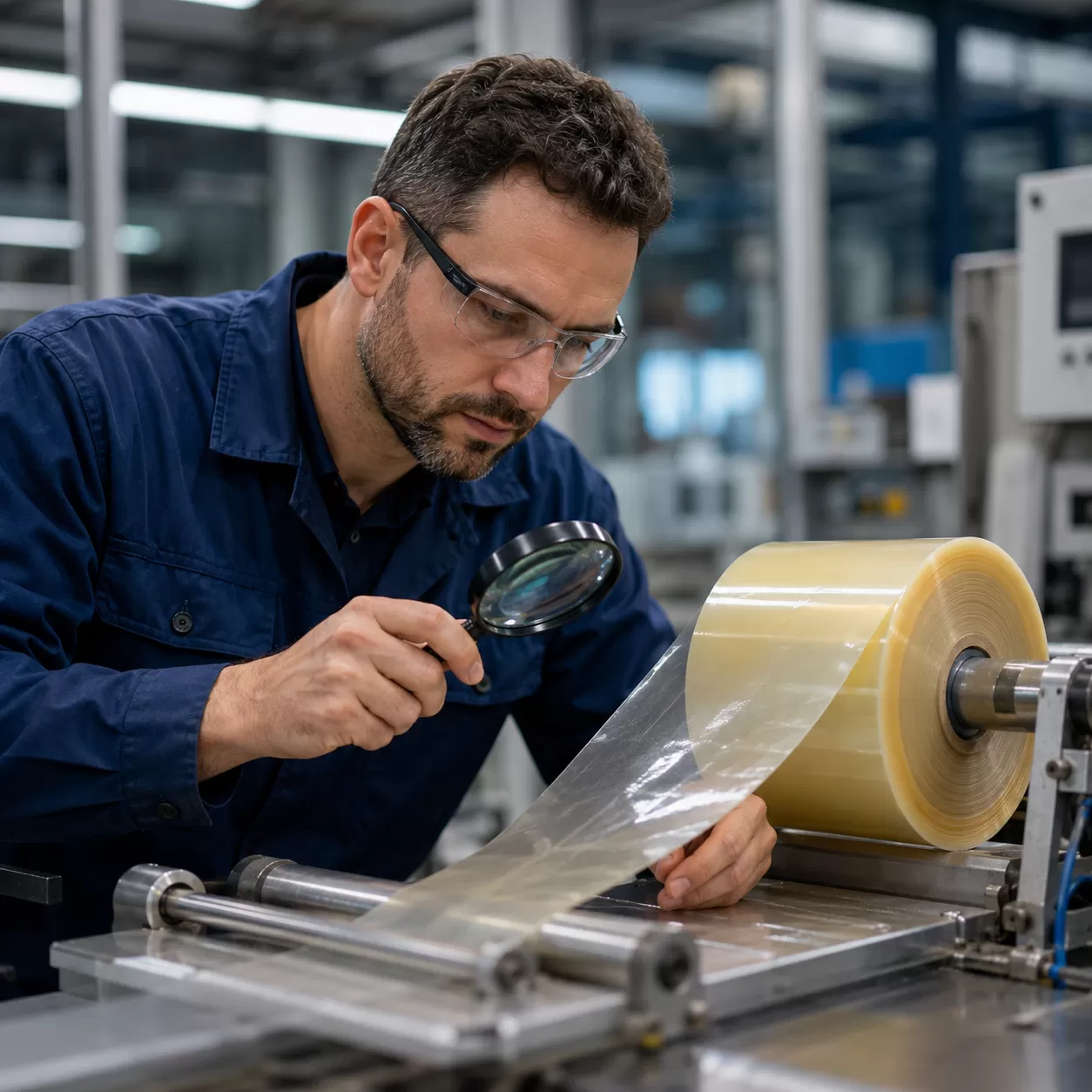
When a trial fails, send the supplier the affected roll or sample, grade and batch, actual process temperatures, coat-weight measurements and the point at which the defect appeared. Separate a defect present immediately after coating from one that develops during winding, storage or use.
Keep a sample made with the approved control under the same conditions. This helps determine whether the candidate grade, a material change or a process change needs attention.
For general investigations of char, stringing, uneven application and weak bonds, use the existing hot melt adhesive Problems guide. Record corrective actions and repeat the relevant approval checks after a material process change.
Request a traceable sample and a comparable quotation
Send the supplier a short brief that includes:
- Label or tape type, dimensions and permanent or removable use.
- Face stock or backing, liner and actual target surfaces.
- Current grade, measured coat weight and the reason for replacement.
- Coating equipment, operating conditions and required production speed.
- Finished-label application temperature and pressure.
- Service exposure, duration, loading and removal requirements.
- Agreed acceptance criteria and an approved control sample where available.
- Trial quantity, expected order volume, delivery destination and required lead time.
Request the TDS, SDS and agreed batch documentation for the named grade. Distinguish typical data-sheet values from purchasing limits and actual lot results. The TDS, SDS and COA guide explains these document roles.
For requirements concerning restricted substances, emissions or a particular end use, request grade-specific documentation with a stated scope. A hot melt processing route alone does not establish every compliance claim.
Compare cost per accepted output after the candidate meets the performance requirements. Include adhesive consumption, production waste and downtime alongside price per kilogram. Agree on lot tolerances and change notification instead of expecting every batch result to be identical.
Frequently asked questions
Is hot melt PSA always better than water-based acrylic for labels?
No. Compare named grades prepared through their correct processes and tested under matched finished-product conditions. The suitable option depends on the surface, construction, converting line and service requirements. Acrylic chemistry is also available in hot melt systems.
Can softening point guarantee summer shipping or freezer performance?
No. It is a bulk-material test result. Summer approval needs relevant environmental and load testing of the finished bond. Freezer approval also needs the actual application temperature, moisture condition and cold-storage sequence.
Does a freezer service rating mean a label can be applied to a frozen package?
No. Minimum application temperature and service temperature describe different stages. Confirm the grade’s application requirements and test the intended package surface at the time of labeling.
Should every grade use the same coating settings for a fair comparison?
No. Use each grade’s documented preparation conditions, including drying or crosslinking where required. Match the finished construction and test conditions as closely as practical, and disclose any differences.
What should be approved before placing a bulk order?
Approve the named grade in the intended construction, its production window and relevant service performance. Record purchasing limits, required documents and change-control arrangements. Send your substrate samples and trial brief to KAISUN to request a candidate grade and quotation.


