

Why Hot Melt Technology Dominates Modern Mattress Production Lines
We design modern mattress assembly lines for speed, precision, and durability. Traditional water-based or solvent-borne adhesives simply cannot keep up with the demands of high-throughput manufacturing. As a leading provider in this space, we have engineered our hot melt adhesive for mattress manufacturing to solve production bottlenecks while elevating final product quality.
Our advanced hot melt formulations dominate the industry because they replace slow-drying alternatives with a highly efficient, clean, and reliable bonding process. Here is exactly why top mattress manufacturers rely on our technology.
100% Solids Formulation
Our mattress adhesive consists of a 100% solids formulation. Because it contains zero water and zero solvents, it offers massive advantages for your production floor:
- Zero Drying Time: No evaporation is needed, eliminating the need for space-consuming drying ovens.
- Solvent-Free Bonding: Our formulas deliver a safer workplace with low VOC emissions.
- No Substrate Warping: Moisture can degrade foam over time; our water-free formulas protect the integrity of your materials.
- Cost-Efficient Shipping: You only pay for active bonding materials, not the weight of water or carrier solvents.
Immediate Initial Tack & Rapid Green Strength
In a fast-moving factory, waiting for a bond to set paralyzes your throughput. Our hot melts deliver an aggressive initial tack the moment they hit the substrate.
| Feature | Performance Benefit | Production Impact |
|---|---|---|
| Instant Grab | Holds springy pockets and dense foam layers in place immediately. | Eliminates clamping and holding times. |
| Rapid Green Strength | The bond achieves structural handling strength within seconds. | Mattresses can move straight to the next assembly station or packaging area. |
| High Yield | Exceptional delamination resistance under immediate tension. | Decreases factory defects and reworking costs. |
Superior Thermal Stability
Our hot melts are engineered to withstand extreme environmental conditions without losing their grip. Once applied, the adhesive remains highly stable across a wide temperature spectrum.
- Char Resistance: The adhesive resists degradation and charring inside the melt tanks, which prevents nozzle clogs and cuts down on equipment maintenance.
- Climate Resilience: Whether your mattresses are stored in a freezing warehouse or shipped in a scorching shipping container, the bond retains its flexibility and strength.
- Long-Term Durability: It resists aging and oxidation, ensuring the mattress layers stay permanently bonded for the entire lifespan of the product.
Substrate Breakdown: Solving Specific Mattress Bonding Challenges

Every layer inside a modern mattress has its own unique texture, tension, and role. We don’t believe in a one-size-fits-all approach. To prevent delamination resistance failure and build a bed that lasts, you have to match the right hot melt adhesive for mattress production to the specific substrates you are putting together.
Here is exactly how we solve the unique bonding challenges for each critical mattress component.
Foam-to-Foam & Foam Layering Assembly
Building a high-end multi-layer bed means bonding highly porous materials like memory foam, latex, and high-density polyurethane blocks. The challenge here is avoiding a hard, noisy “glue line” that ruins the contouring feel of the bed.
- The Solution: We use a specialized foam bonding hot melt adhesive applied in a light, uniform pattern.
- Deep Bonds: The adhesive penetrates the open cells of the foam without sinking in too deep or wasting material.
- Soft Hand-Feel: The joint stays perfectly flexible, moving naturally with the foam layers as they compress and recover.
Fabric Lamination & Cover Ticking
The top cover—or ticking—is what the customer sees and feels first. Bonding delicate top fabrics to underlying comfort foam requires extreme precision to avoid puckering, shifting, or bleeding through the textile.
- Low-Temperature Application: Our formulations apply at lower temperatures to protect heat-sensitive synthetic fibers from shrinking or scorching.
- Zero Bleed-Through: Controlled viscosity ensures the adhesive stays right at the interface, securing the fabric flat without hardening the surface.
- Instant Lay-Flat: Keeps quilted covers perfectly aligned during high-speed cutting and sewing.
Nonwoven Material & Pocket Spring Assembly
Pocket spring units are the hardworking core of the mattress, undergoing constant, intense mechanical stress. Fastening hundreds of individual nonwoven fabric pockets together requires an exceptionally tough pocket spring assembly glue that can handle non-stop flexing.
- High Dynamic Strength: The bond must withstand continuous shear forces from compression without cracking or snapping.
- Silent Performance: Eliminates any clicking or squeaking noises when the springs move against each other.
- High-Speed Machine Compatibility: Features a sharp setting time that aligns perfectly with automated, high-output pocket coil assembly lines.
Mattress Substrate Bonding Guide
| Substrate Pair | Key Requirement | Recommended Application Style |
|---|---|---|
| Foam to Foam | High flexibility, zero stiff spots | Wide-pattern swirl spray |
| Fabric to Foam | Low-temp bond, no bleed-through | Fine mist / Multi-bead |
| Nonwoven to Nonwoven (Springs) | Extreme shear strength, zero noise | Solid bead or dense swirl |
Advanced Polymer Formulations: Finding the Perfect Technical Match
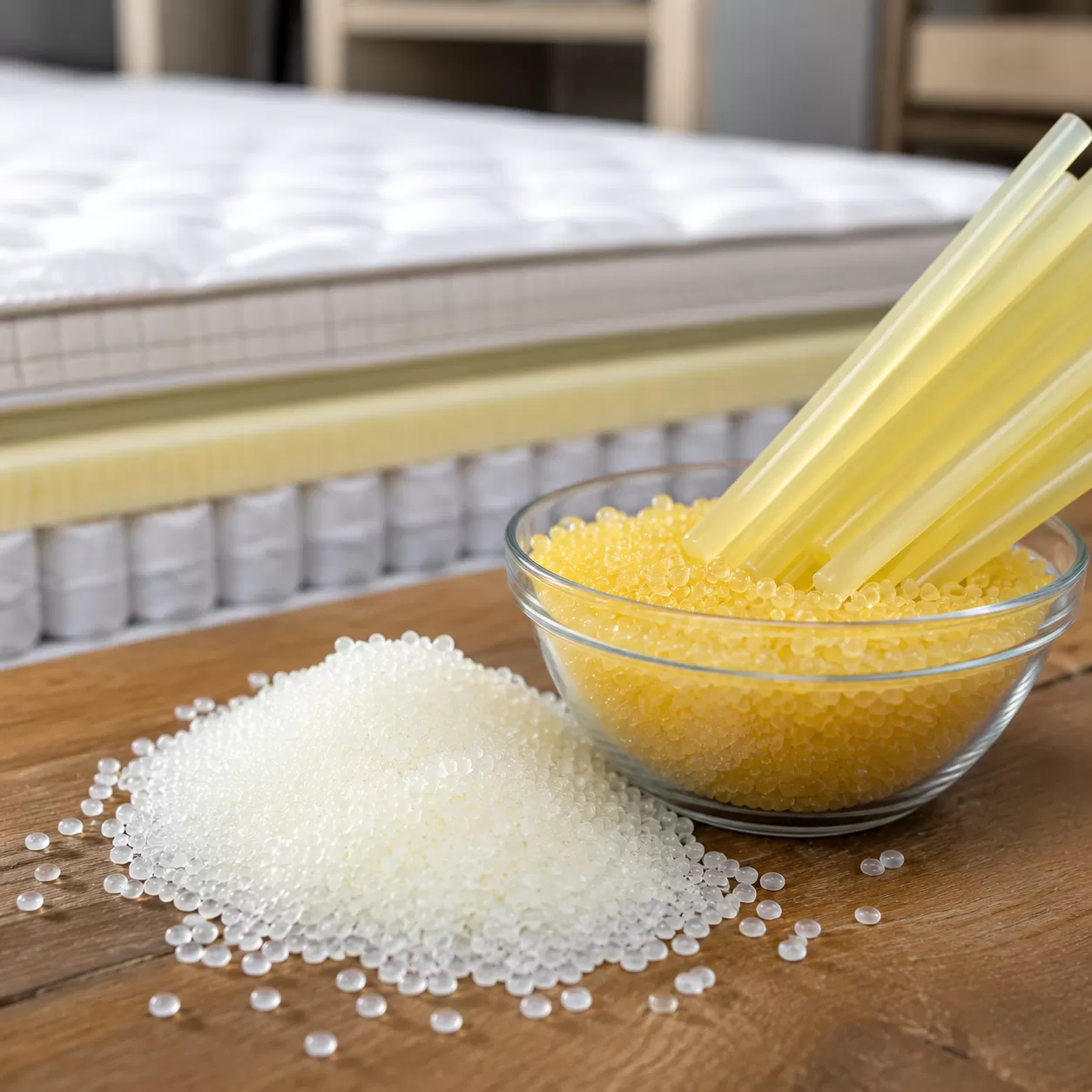
Different mattress designs call for different chemistry. We formulate our hot melt adhesive for mattress production using three core polymer types to handle specific stress, material, and production line setups.
APAO (Amorphous Poly-Alpha-Olefins) Hot Melts
APAO formulations are the workhorses for heavy-duty foam bonding hot melt adhesive applications. They offer an exceptionally long open time window, making them ideal for manual assembly lines where workers need time to align large foam layers perfectly. Once set, APAO delivers extreme heat resistance and deep material penetration, ensuring long-term delamination resistance even under constant body weight.
PO (Polyolefin) & Synthetic Rubber-Based PSAs
For high-speed, automated lines, our rubber-based pressure-sensitive adhesive (PSA) solutions provide that instant, aggressive initial tack. These adhesives stay permanently tacky and flexible, which is exactly what you need for pocket spring assembly and high-flex border wrapping. They absorb movement effortlessly, eliminating the friction that causes noisy mattresses.
PUR (Polyurethane Reactive) Hot Melts
When you need the absolute highest bond strength possible, PUR hot melt adhesive is the go-to chemistry. It cures using ambient moisture to create an irreversible chemical bond. This is our premier mattress adhesive for luxury, heavy-duty layering and high-stress nonwoven lamination. It remains perfectly flexible while offering unmatched resistance to heat, aging, and roll-packing forces.
Quick Polymer Comparison Matrix
| Polymer Base | Key Strength | Best Used For | Open Time |
|---|---|---|---|
| APAO | Long open time, high heat resistance | Manual foam layering, core assembly | Long (Up to several minutes) |
| Rubber PSA | Permanent flexibility, instant tack | Pocket spring assembly, top-layer comfort foam | Immediate / Infinite |
| PUR | Irreversible chemical bond, max durability | Luxury layering, high-tension fabric bonding | Short to Medium |
Optimizing Application Methods for Maximum Throughput
Getting the most out of your hot melt adhesive for mattress assembly comes down to how you apply it. On a fast-moving production line, the right application method directly impacts your speed, material costs, and bond strength.
Automated Spray vs. Swirl Application
Choosing between automated spray and swirl systems depends entirely on the specific mattress layers you are bonding and your production goals. For manufacturers comparing chemistry, line speed, open time, and substrate requirements, our hot melt adhesive selection guide can help narrow down the right adhesive type before production testing.
| Application Method | Best Used For | Key Advantages |
|---|---|---|
| Automated Spray | • Fabric lamination • Cover ticking • Large-surface foam layering | • Maximum surface coverage • Uniform adhesive distribution • Fastest line speeds |
| Swirl Application | • Pocket spring assembly • Foam-to-foam borders • High-stress joints | • Thick, structural adhesive beads • Superior delamination resistance • Lower overspray waste |
Fine-Tuning Technical Parameters
To keep your mattress adhesive performing at its peak, your equipment settings must align with the technical properties of your formulation. We focus on three critical variables to ensure zero downtime and clean application:
- Melt Viscosity Control: Maintaining the exact operating temperature ensures the foam bonding hot melt adhesive flows smoothly without drooling or stringing.
- Open Time Window: The application speed must match the open time of the adhesive. If the open time window is too short, the adhesive chills before bonding; if it is too long, the mattress layers will shift during compressed packaging.
- Air Pressure & Pattern Width: For swirl spray application, precise air pressure control delivers a consistent pattern that drives deep into nonwoven lamination without burning through delicate fabrics.
Meeting 2026 Global Trends: Sustainability & Compressed Packaging
The mattress manufacturing landscape shifts rapidly, and our focus is locked on the two biggest drivers in the United States market today: extreme roll-compression and eco-conscious manufacturing. To stay competitive, production lines require a specialized hot melt adhesive for mattress assembly that handles these modern demands without breaking a sweat.
The “Bed-in-a-Box” Revolution
The booming e-commerce market relies entirely on specialty roll-packed mattress adhesive technology. Heavy-duty automated presses fold and roll a mattress into a box a fraction of its original size, putting immense mechanical stress on every single bond line.
- Zero Delamination: Our formulations provide the ultimate delamination resistance, keeping foam layers perfectly aligned even under tons of constant pressure.
- Instant Recovery: When the end-user unboxes the mattress, the glue line flexes and recovers instantly, preventing deep creases or structural splitting.
- 100% Core Integrity: Pocket spring assembly zones stay locked in place, ensuring the mattress pops back to its exact intended shape without shifted coils.
The Circular Economy & Eco-Conscious Formulations
American consumers and regulators demand greener products, and our solvent-free bonding solutions help you deliver exactly that. Switching to advanced hot melt adhesive for mattress manufacturing eliminates the need for harsh chemicals in the plant while improving the sustainability profile of the final product.
- Low VOC Emissions: Protects indoor air quality both on your production floor and in the customer’s bedroom.
- Greener Chemistry: Formulated to support end-of-life mattress recycling and circular economy initiatives by allowing easier material separation.
- Energy Efficiency: Lower application temperatures reduce your facility’s energy footprint while maintaining a flawless foam bonding hot melt adhesive bond.
Frequently Asked Questions: Hot Melt Adhesive for Mattress Manufacturing
What is the best adhesive for mattress pocket spring assembly?
For pocket spring assembly, APAO (Amorphous Poly-Alpha-Olefin) hot melts and specialized synthetic rubber-based PSAs are the top choices. They offer the perfect balance of rapid initial tack to keep up with fast automated production lines and high delamination resistance to hold the springs firmly under constant tension. They bond instantly to nonwoven fabrics without leaking through the material.
How does hot melt adhesive prevent noise in mattresses?
No one wants a squeaky bed. Unlike water-based options that can dry out and crack, or mechanical fasteners that rub, our foam bonding hot melt adhesive remains highly flexible and elastomeric after curing. It creates a permanently resilient bond between pocket springs, foam layers, and fabric. This flexible barrier absorbs friction and dampens movement, completely eliminating click-and-squeak noises.
Can hot melt adhesives withstand bed-in-a-box roll compression?
Yes, the right formulations handle it perfectly. The bed-in-a-box packaging trend puts extreme stress on glue lines during the roller-crushing and vacuum-sealing process. Our advanced roll-packed mattress adhesive formulas are engineered with high elongation and memory properties. They endure intense compression for months and pop back up without delaminating when the customer unboxes the mattress.
What is the open time window required for manual mattress assembly?
For manual assembly lines, you need a longer open time window—typically between 2 to 5 minutes. This gives operators enough time to align large foam layers and wrap fabric cover ticking perfectly before the adhesive sets. For fully automated swirl spray application lines, we dial the open time down to a few seconds to maximize throughput and speed up packaging.
If you are unsure which polymer base or application method fits your mattress production line, choosing a reliable hot melt adhesive manufacturer with formulation experience and technical support can reduce testing risk. You can also contact us to discuss your substrate, line speed, open time, and bonding requirements.


