
Choose envelope adhesive for the specific bond task. A side seam, a window patch and a user-activated front closure involve different contact surfaces, application methods and acceptance tests. A grade suitable for one operation may be unsuitable for another.
Envelope manufacturers and converters should define the joint and decide when it must hold or open before requesting samples or a quotation. Those requirements determine which closure route and application details the supplier needs to review.
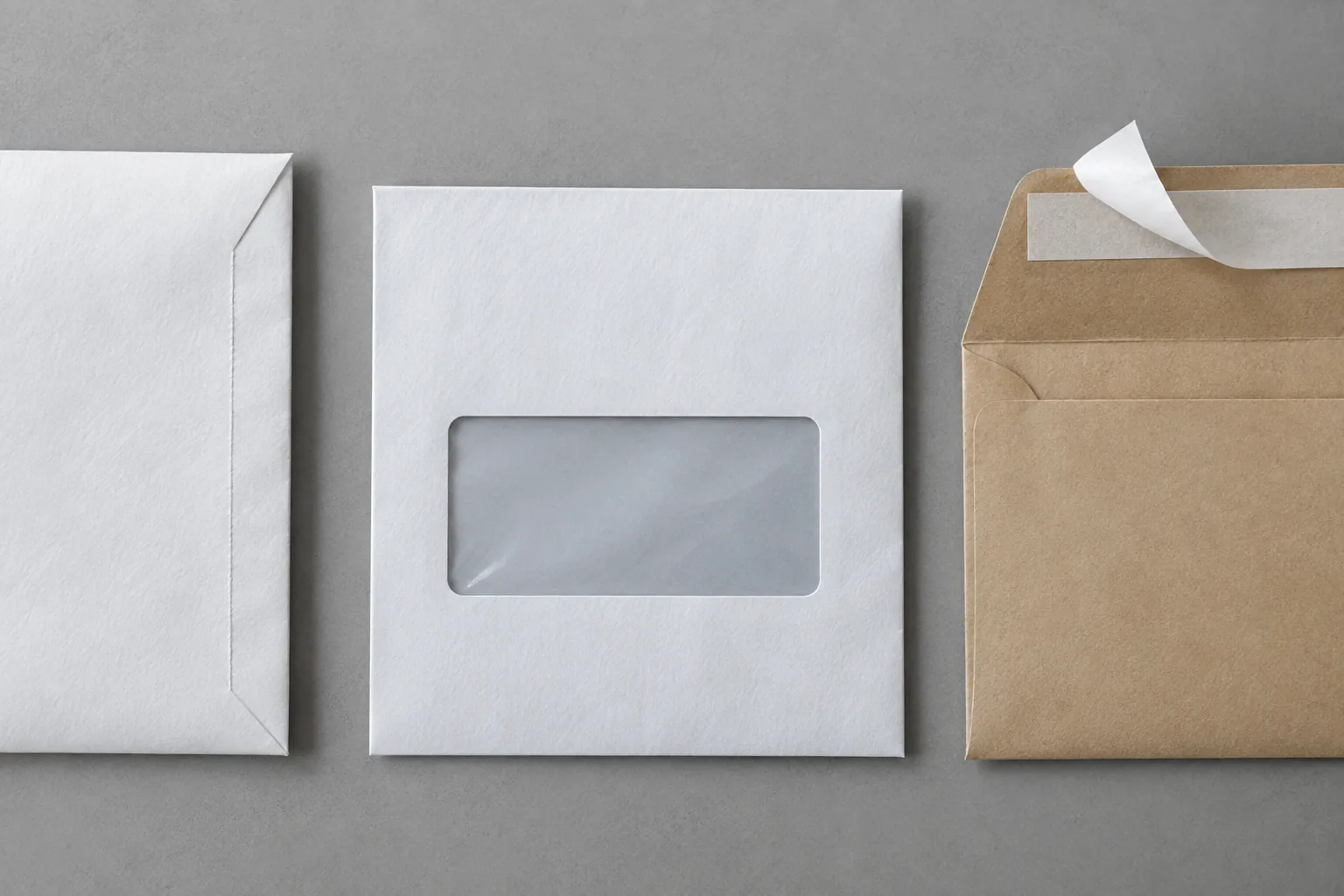
Start with the three envelope bond tasks
1. Side and back seams
Side seams and back seams join folded paper panels. The adhesive must wet the selected paper quickly enough for the folder and compression section to make a consistent joint. Paper porosity, coating, caliper, fold geometry and the amount of adhesive all affect the result.
The seam may be a continuous narrow line or an interrupted pattern, depending on the envelope design and equipment. A process that applies too much adhesive can create squeeze-out, show-through or blocking in the stack. Too little adhesive can leave an unbonded section that opens during packing or mailing.
2. Window patches
A window patch joins a transparent film to paper. This is a different interface from paper to paper. The film may have a surface treatment or coating, while the paper may be printed, coated or recycled. Adhesive placement, film tension and application pressure over the patch can matter as much as the adhesive family.
Inspect the complete construction during the trial. Check the film edge, the paper around the window, optical appearance and any lifting after handling. Do not approve a window adhesive from a paper seam test alone.
3. Front closure
The front closure should match how the user opens and closes the envelope. Common industrial routes include remoistenable gum, latex cohesive self-seal and peel-and-seal pressure-sensitive adhesive. These are not interchangeable terms.
Remoistenable systems are activated by moisture at the time of closing. Relevant production and end-user factors include coating uniformity, drying, storage and the amount of moisture needed for activation. A self-seal construction uses complementary adhesive surfaces that bond when pressed together. A peel-and-seal construction uses a pressure-sensitive adhesive covered by a release liner until the envelope is closed.
Water-based PSA and hot-melt PSA are possible industry routes for peel-and-seal closures. The terminology for commercial closures varies, so confirm the construction with the supplier.
Select the closure route against the envelope format, filling process, required user action, storage conditions and available equipment. The phrase “envelope adhesive” does not specify a chemistry or delivery form.
Compare the main closure routes
| Closure route | Activation or use | Main interfaces to check | Typical trade-off to evaluate |
|---|---|---|---|
| Remoistenable | Moisture activates the coated closure before pressing the flap | Paper coating, gum coat, drying and moisture exposure | Familiar closure behavior, but production and end-use activation must be controlled |
| Latex cohesive self-seal | Matching coated areas bond when pressed together | Cohesive pair, paper, coating laydown and storage | No separate liner, but both mating surfaces and their alignment must work together |
| Peel-and-seal hot melt PSA | User removes a release liner and presses the flap | PSA, liner, flap paper, dust and application pattern | Convenient dry closure, but liner handling, tack, peel and storage need validation |
Use this comparison to frame the supplier review, not as a substitute for testing. The adhesive selection still depends on the exact paper, film, liner and line conditions. When evaluating a pressure-sensitive adhesive for envelopes, distinguish the adhesive layer from the finished envelope construction. The liner, flap geometry and release behavior can change the user’s result even when the adhesive itself is unchanged.
When comparing pressure sensitive adhesive envelopes, evaluate how the adhesive, liner and flap work together in the finished construction. Material names alone do not predict closure performance.
The PSA hot melt adhesives page explains the broader chemistry. Use it to frame the supplier discussion, then trial the buyer’s actual envelope construction.
Match adhesive behavior to substrates and equipment
Paper and coatings
Record the paper grade, basis weight or caliper if available, recycled content, coating, ink coverage and any varnish or barrier layer. A printed area can behave differently from an unprinted paper edge. Recycled fibers can also vary between lots. If the adhesive must bond over a coated zone, test that zone directly rather than assuming that an uncoated paper test represents it.
Window film
Identify the window film and its treated or coated side. State whether the adhesive is applied to the film, paper, or both. Note the overlap width and whether the patch is flat, curved or under tension during application. Film lift, edge curl and optical defects should be recorded separately from adhesive failure.
Release liner and closure geometry
For peel-and-seal formats, specify the liner construction and the adhesive coat area. The supplier needs to know whether the liner is removed by hand, by an automatic feeder or by another process. Flap length, fold accuracy and compression affect the contact area. A strong adhesive cannot compensate for a closure that does not align.
Application method
The line may apply adhesive as a bead or spray, or through a roll or slot die. Each method places different demands on viscosity, laydown control, open time and cleaning. Use hot melt adhesive application methods to map the adhesive to the equipment. Give the supplier the applicator type, heated zones, nozzle or slot details, line speed, substrate temperature and whether the line stops frequently.
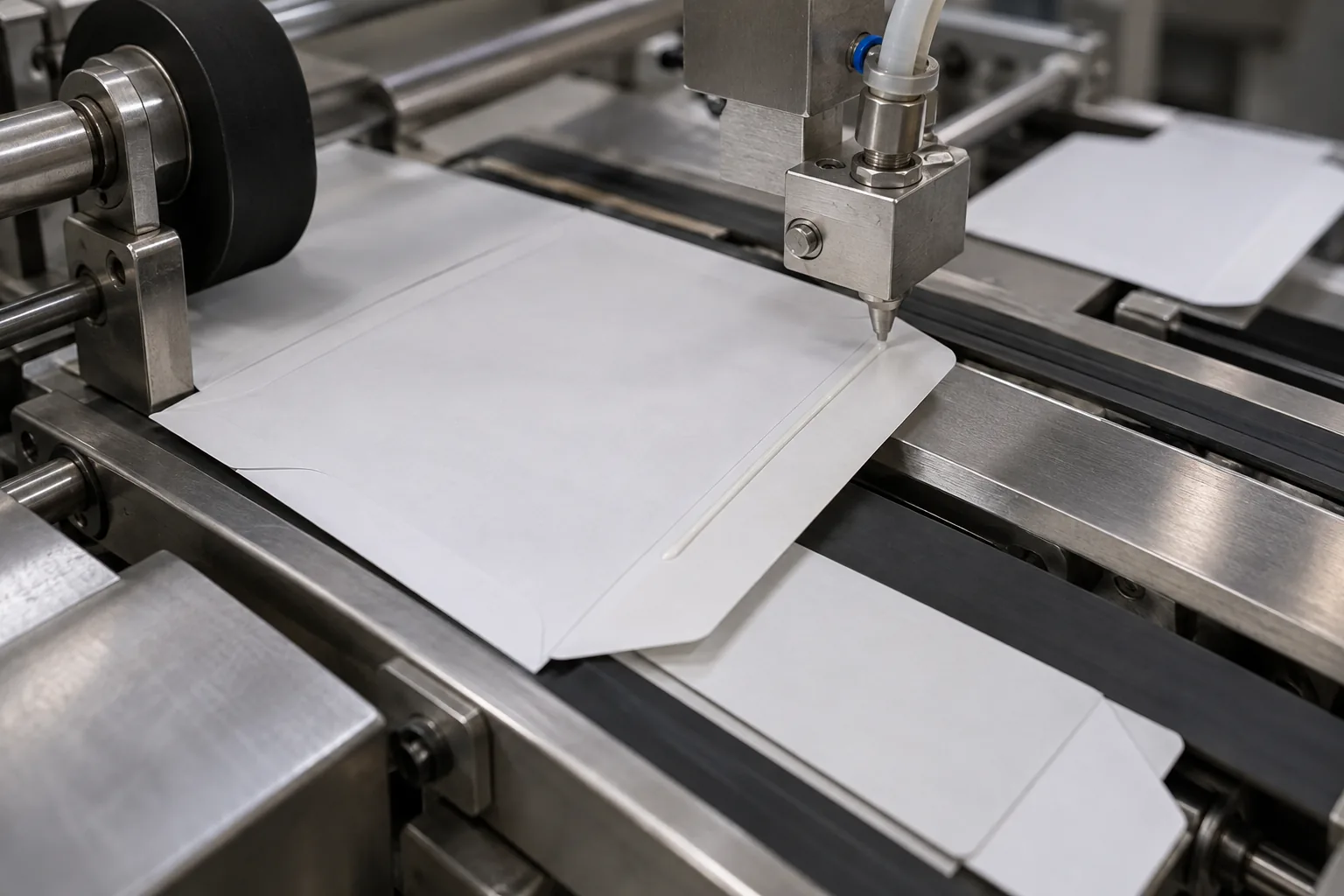
Treat application temperature as a process setting, separate from service temperature, softening point and cure time. Ask for the relevant grade documents and confirm which value applies to the decision being made.
Storage and closure validation
Envelope adhesive can pass an immediate bond check and still fail after storage. Include a defined conditioning period before approval. Store finished samples in the conditions expected in production, warehousing and distribution, then inspect the closure and seam again.
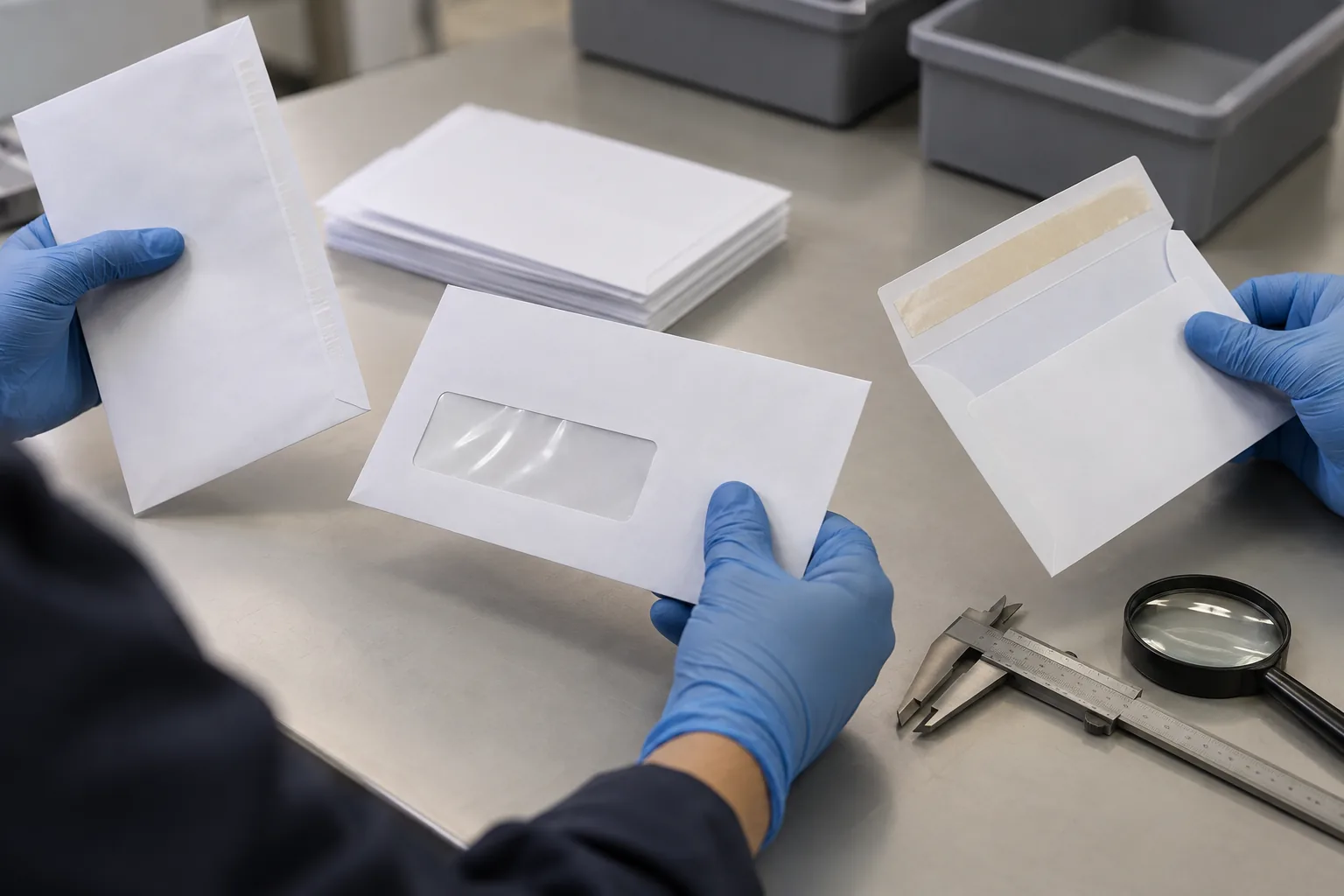
For a remoistenable closure, check activation consistency after storage and whether the coated area remains usable. For a self-seal closure, check whether the two surfaces still mate and close as intended. For a peel-and-seal construction, check liner release, exposed adhesive contamination, flap adhesion and opening behavior.
Record the following observations for the adhesive and the finished envelope:
- Seam opening along the bond line
- Fiber tear, paper delamination or clean adhesive separation
- Window edge lift or film curl
- Flap opening during handling
- Liner release that is too difficult or too easy
- Blocking between stacked envelopes
- Staining, show-through or visible adhesive lines
- Loss of closure after conditioning
For pressure-sensitive adhesive, organize testing around peel, tack and shear. Interpret the values only when the substrate, dwell, peel angle, temperature and test method are controlled. See hot melt PSA testing for peel, tack and shear for the testing framework. Do not transfer a result from a label face stock to an envelope flap without checking the construction and conditions.
Common envelope adhesive failure modes
| Symptom | Likely causes to investigate | Evidence to collect before changing grade |
|---|---|---|
| Side seam opens at one section | Interrupted bead, poor folding pressure, dusty paper or uneven laydown | Failure location, bead pattern, fold alignment and paper surface |
| Adhesive shows through the paper | Excess laydown, porous paper or excessive pressure | Coat weight or setting record, paper construction and visual map |
| Window patch lifts at the edge | Film surface, edge geometry, tension or incomplete contact | Film side, overlap, pressure, edge shape and failure interface |
| Peel-and-seal flap does not hold | Wrong adhesive interface, liner contamination, low contact area or insufficient pressure | Liner type, flap alignment, dwell, pressure and storage history |
| Closure is difficult to open | Excessive adhesion, unsuitable liner release or too much contact area | Opening direction, liner behavior, adhesive area and opening observations |
| Stack blocks during storage | Residual tack, pressure, heat or insufficient separation | Stack height, storage conditions, time, surface contact and packaging |
| Closure loses performance after storage | Paper migration, contamination, conditioning or adhesive aging | Lot identity, storage history, substrate changes and retest conditions |
Investigate the process and materials before changing adhesive. A paper lot, coating, applicator temperature, nozzle condition, compression section or fold setting may have changed. Record where the failure occurs and which interface separates. That evidence helps distinguish adhesive failure from paper or process failure.
What affects process risk and total cost?
Unit price alone does not show the total cost of envelope production. Compare the amount applied per envelope, line waste, cleanup, liner handling, rejected units, stack blocking and the time needed to approve a change. A closure route with a liner may add material and a handling step. A remoistenable route may shift more control to coating, drying and end-use activation. A self-seal construction may require accurate mating surfaces.
Equipment changes can also affect the decision. A hot melt route may require heated supply and application components. A water-based adhesive route may require coating and drying control. A remoistenable closure also requires control of coating and drying. Ask what must be changed on the line and what happens during stops, starts and product changeovers. Review the operating method with production and maintenance teams before comparing only adhesive unit price.
RFQ checklist for an envelope adhesive
Send the supplier enough detail to distinguish the bond task and the test conditions. Include:
- Envelope construction and dimensions, with drawings or photos of the seam, window and closure.
- Paper grade, caliper or basis weight, coating, ink or varnish, and recycled content where relevant.
- Window film type, treated side and overlap geometry, if applicable.
- Closure route under consideration: remoistenable, cohesive self-seal or peel-and-seal PSA.
- Adhesive application method, equipment type, heated zones, nozzle or coating head, and line speed.
- The application temperature or process window already used, plus line stop and restart conditions.
- Required open time, compression or dwell conditions, and when the envelope is handled after application.
- Storage, shipping and end-use conditions, including expected heat, cold, humidity and stacking.
- Acceptance criteria: seam hold, flap opening, liner release, fiber tear, appearance, blocking and conditioning results.
- Annual or batch volume, packaging format required for the line, and the documents needed for technical approval.
Define the joint and opening behavior instead of asking for “the strongest envelope adhesive.” Strength, tack, peel and cohesive behavior can pull the design in different directions. A supplier can review the application more effectively when the construction, process and failure criteria are stated together.
Next step for a technical inquiry
If you are sourcing envelope adhesive, send the seam or closure drawing, substrate details, application method, line conditions and test requirements with your inquiry. Include representative samples or photos when the window film, coating or liner is important. Use the contact form to provide the application and quantity, and describe any attachments available for review.
Approve an adhesive route only after it creates the required seam, window bond or closure on the actual construction and runs on the available equipment. The finished envelope must also remain stable through storage and meet the buyer’s opening and appearance requirements.


