
Choosing a profile wrapping adhesive should start with the substrate, wrapping material, production line, and finished-product requirements—not with PUR, EVA, or polyolefin chemistry alone.
PUR is often evaluated where demanding heat, moisture, or durability performance is required. EVA and polyolefin can remain practical choices for selected interior applications and production conditions.
The right adhesive is the grade that runs consistently on your equipment, bonds your actual materials, and passes the required finished-profile tests.
Need a profile wrapping adhesive recommendation?
Send us your profile substrate, wrapping material, application method, line speed, current adhesive, and current problem. KAISUN can help narrow the adhesive direction and recommend a candidate grade for production testing.

Quick Profile Wrapping Adhesive Selection Guide
Use this table to narrow the first grades worth testing.
| Application Condition | Possible Starting Direction | What Must Be Confirmed |
|---|---|---|
| MDF + decorative paper or selected foil for interior furniture | EVA / PO / PUR depending on requirements | Wet-out, appearance, heat exposure, line timing |
| MDF + CPL or relatively rigid decorative material | PUR or suitable thermoplastic grade | Spring-back, green strength, open time |
| PVC/WPC profile + decorative film | PUR or selected PO grade | Surface compatibility, treatment, processing conditions |
| Aluminum profile + decorative foil | Frequently PUR | Pretreatment, rapid heat loss, foil compatibility |
| Window or construction profile | Frequently PUR | Heat, moisture, weathering, customer test requirements |
| Moderate interior profile | EVA, PO, or PUR depending on process | End-use environment and production economics |
| Tight-radius or complex profile | Grade with suitable open time and green strength | Geometry, roller pressure, material stiffness |
There is no universal chemistry that automatically fits every profile-wrapping application.
Two PUR grades can have very different viscosity, open time, green strength, and processing behavior. The same applies to EVA and polyolefin formulations.
What Makes Profile Wrapping Adhesive Selection Difficult?
Profile wrapping continuously bonds a decorative material around a shaped core.
Unlike flat lamination, the wrapping material may have to pass around:
- outside corners;
- inside grooves;
- narrow radii;
- multiple changes in direction;
- complex decorative profiles.
The adhesive therefore has to work during both coating and forming.
Several variables can determine whether the finished profile remains stable.
Wrapping Material Spring-Back
CPL, veneer, thicker films, and other relatively rigid facings naturally try to return toward their original shape.
The adhesive needs enough early holding strength to keep the wrapping material in contact with the profile while the bond develops.
Substrate Heat Transfer
An aluminum profile can remove heat from hot melt much faster than MDF.
This may shorten the effective wetting and bonding window even when the adhesive temperature displayed by the machine remains unchanged.
Surface Energy and Pretreatment
PVC, PP, PET, coated materials, aluminum, and wood-based profiles do not present the same bonding surface.
Depending on the materials, preparation may involve:
- cleaning;
- primer;
- corona treatment;
- flame treatment;
- other supplier-approved pretreatment.
Do not assume that every PVC or aluminum profile requires the same pretreatment.
The actual substrate, wrapping material, and adhesive system should be tested together.
Line Timing
The important question is not simply:
“How fast is your machine?”
A more useful question is:
How much time passes between adhesive application and effective pressure contact?
That interval must remain inside the usable open-time window of the selected grade.
For more detail, see our guide to hot melt adhesive viscosity, open time and setting time.
PUR vs EVA vs Polyolefin for Profile Wrapping
Adhesive chemistry is a useful starting point, but buyers should compare specific grades under matched production conditions.
PUR Profile Wrapping Adhesive
Polyurethane reactive hot melt adhesive develops initial handling strength during cooling and then continues reacting with moisture.
Suitable PUR formulations are commonly evaluated for profile wrapping involving materials such as:
- MDF and other wood-based profiles;
- veneers;
- CPL;
- thermoplastic foils;
- PVC profiles;
- suitably prepared aluminum profiles.
PUR may be particularly relevant where the finished profile has demanding requirements involving heat, moisture, or environmental exposure.
However, PUR itself is not a complete specification.
For each candidate grade, confirm:
- viscosity and measurement temperature;
- recommended processing conditions;
- usable open time;
- green strength;
- cure or conditioning requirements;
- substrate preparation;
- final environmental performance;
- storage and handling requirements.
EVA Hot Melt for Profile Wrapping
EVA hot melt adhesives are thermoplastic systems that develop their bond mainly through cooling and solidification.
Selected EVA grades may remain practical for profile-wrapping applications where:
- the material combination is compatible;
- the geometry is manageable;
- the service environment is moderate;
- the processing window fits the production line;
- production cost is an important selection factor.
EVA should not automatically be treated as a low-performance option.
Different EVA formulations can vary significantly in viscosity, tack, setting behavior, and heat performance.
Polyolefin Hot Melt for Profile Wrapping
Polyolefin hot melt adhesives may be considered where the process requires:
- stable thermoplastic processing;
- compatibility with selected plastics or coated materials;
- a specific open-time or setting profile;
- clean application performance;
- an alternative to conventional EVA or reactive PUR.
As with PUR and EVA, grade-level testing matters more than the chemistry name alone.
PUR vs EVA vs PO: Practical Buyer Comparison
| Selection Factor | PUR | EVA | Polyolefin |
|---|---|---|---|
| Bond mechanism | Cooling followed by moisture reaction | Cooling and solidification | Cooling and solidification |
| Final performance | Can be selected for demanding environmental conditions | Strongly grade- and application-dependent | Strongly grade- and substrate-dependent |
| Processing | Requires moisture-aware handling and suitable equipment | Familiar to many conventional hot melt lines | Usually conventional thermoplastic processing |
| Initial handling strength | Grade-dependent | Grade-dependent | Grade-dependent |
| Open time | Grade-dependent | Grade-dependent | Grade-dependent |
| Heat resistance | Verify cured grade and test method | Verify specific grade | Verify specific grade |
| Moisture resistance | Can be high with a suitable cured grade | Formulation-dependent | Formulation-dependent |
| Cleaning / shutdown | Follow reactive PUR procedures | Conventional hot melt procedures may apply | Conventional hot melt procedures may apply |
| Commercial evaluation | Compare finished-part performance and process cost | Often considered where material cost is important | Compare material cost with process efficiency |
| Final approval | Production trial | Production trial | Production trial |
Do not approve an adhesive from this table alone.
Compare candidate grades using the same substrate, wrapping material, coat weight, production equipment, and finished-product requirements.
For a broader chemistry comparison, see PUR vs EVA hot melt adhesive.
When Is PUR Not Automatically the Best Choice?
PUR can be a strong solution for demanding profile wrapping, but changing to PUR is not automatically an improvement.
A thermoplastic EVA or polyolefin grade may remain the better commercial choice when:
- the finished profile is used in a moderate indoor environment;
- the current thermoplastic adhesive already passes all required tests;
- the production line is optimized for EVA or PO processing;
- reactive PUR handling would add unnecessary equipment or maintenance complexity;
- the main objective is simply to lower adhesive price rather than solve a verified performance problem.
Changing chemistry can introduce new variables involving equipment, storage, cleaning, cure time, and process control.
The correct question is therefore not:
“Is PUR stronger?”
It is:
“Which adhesive gives the required finished-profile performance at the most stable total production cost?”
Match the Adhesive to the Core Substrate
The same wrapping material can behave differently when the core changes.
MDF and Particleboard
Wood-based profiles can be porous and may contain dust or variations in density.
Important variables include:
- surface cleanliness;
- profile density;
- moisture;
- porosity;
- surface temperature;
- adhesive transfer;
- wrapping-material stiffness.
Too little effective adhesive at the interface can create a starved bond.
Excessive adhesive can increase consumption and may contribute to squeeze-out or surface appearance problems.
Solid Wood
Wood species, moisture, machining quality, and contamination can affect bonding.
A result obtained on MDF should not automatically be transferred to solid wood without testing.
PVC and WPC Profiles
Plastic profiles require attention to:
- surface formulation;
- additives;
- release contamination;
- surface energy;
- heat sensitivity;
- primer or pretreatment requirements.
A grade that bonds one PVC formulation may not automatically bond another.
Aluminum and Metal Profiles
Metal removes heat quickly from the adhesive interface.
This can shorten the usable wetting window.
When evaluating aluminum profile wrapping, confirm:
- cleaning;
- surface preparation;
- primer if applicable;
- profile temperature;
- adhesive open time;
- pressure contact position;
- wrapping-material compatibility.
Match the Adhesive to the Wrapping Material
The facing material creates another set of variables.
PVC and Other Thermoplastic Films
Check:
- film formulation;
- surface treatment;
- primer;
- plasticizer system where relevant;
- thickness;
- stiffness;
- heat sensitivity;
- surface condition.
A supplier can make a better recommendation when the actual film construction is known rather than simply receiving the description “PVC foil.”
PP and Other Low-Surface-Energy Materials
Low-surface-energy materials can be more difficult to wet.
Pretreatment and adhesive selection may therefore become more important.
PET Film
PET materials can vary in coating and surface treatment.
Always evaluate the real commercial film.
CPL and Rigid Decorative Materials
CPL and other relatively rigid facings may create greater restoring force around corners.
The production trial should evaluate:
- surface wetting; and
- early bond strength around the profile geometry.
Natural Wood Veneer
Natural veneer can vary in:
- species;
- thickness;
- moisture;
- rigidity;
- surface condition.
A grade that performs well with flexible film may require different conditions when wrapping veneer.
What Should Be Tested for Different Material Combinations?
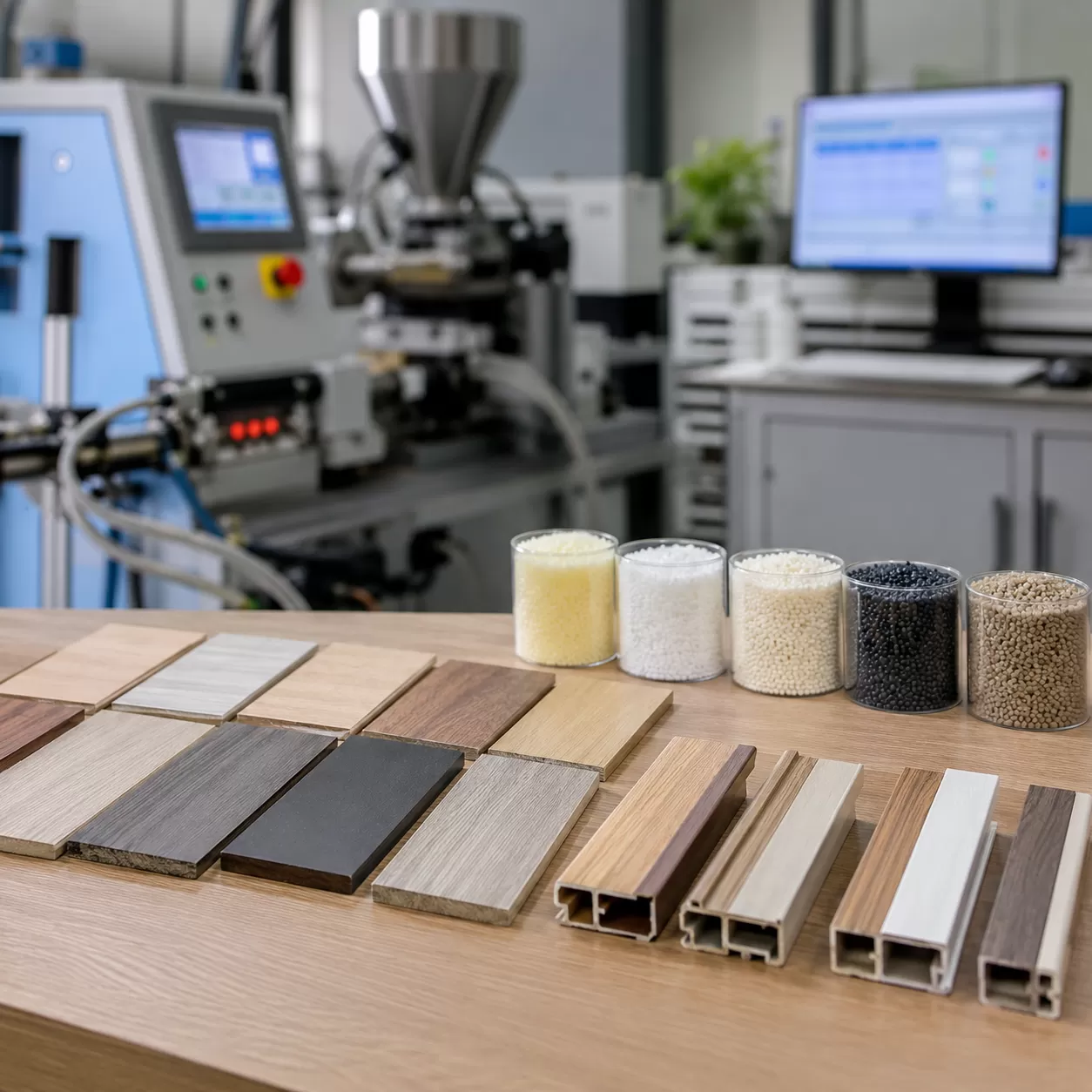
Instead of assigning one chemistry to every material combination, use the matrix below to identify the main risks that should be evaluated during the trial.
| Core | Wrapping Material | Main Risk | What to Test |
|---|---|---|---|
| MDF | Decorative paper | Absorption / surface appearance | Wet-out, coat uniformity, visible surface defects |
| MDF | PVC film | Interface compatibility | Peel behavior, edge stability, aging |
| MDF | CPL | Spring-back | Green strength, tight-radius retention |
| MDF | Veneer | Porosity / stiffness | Wet-out, material tension, finished bond |
| PVC | PVC film | Surface compatibility | Pretreatment, wet-out, heat sensitivity |
| WPC | Decorative film | Surface formulation | Adhesion after aging and environmental exposure |
| Aluminum | Thermoplastic foil | Rapid heat loss | Open time, wet-out, profile temperature |
| Aluminum | Rigid facing / veneer | Heat loss + restoring force | Early strength, surface preparation, aging |
This matrix helps define a useful trial plan without implying that one adhesive chemistry is guaranteed to work.
What Parameters Matter Most on a Profile Wrapping Line?
Many problems described as “poor adhesive strength” are actually caused by a process window that does not match the grade.
1. Viscosity
Viscosity affects:
- adhesive transfer;
- coating uniformity;
- wet-out;
- delivery pressure;
- penetration into porous materials;
- effective coating thickness.
Always compare viscosity together with the test temperature and test method.
A viscosity value measured under one condition should not be directly compared with a value measured under another.
2. Open Time
Open time needs to cover the actual interval between application and effective contact.
It can be influenced by:
- substrate temperature;
- adhesive mass;
- profile dimensions;
- ambient conditions;
- metal heat loss;
- production speed;
- coating location;
- distance to the wrapping rollers.
3. Setting and Green Strength
After the profile leaves the pressure zone, the bond needs enough early strength to resist:
- edge lifting;
- spring-back;
- movement;
- local separation.
Open time and green strength are related to the process but should not be treated as the same property.
4. Coat Weight
There is no single universal coat weight for profile wrapping.
The required amount depends on:
- substrate porosity;
- surface roughness;
- facing material;
- profile geometry;
- adhesive rheology;
- coating method;
- finished-product requirements.
Use the grade supplier’s recommended starting conditions and then determine the lowest stable coating level that still meets the required performance.
5. Substrate Temperature
Substrate temperature can be particularly important with:
- aluminum;
- thick profiles;
- cold factory conditions;
- high-mass components.
The adhesive temperature displayed by the equipment does not necessarily represent the temperature at the actual bonding interface.
Roller or Slot-Die Application?
Profile-wrapping lines can use different coating systems, so the adhesive must fit the actual equipment.
For a broader equipment comparison, see our guide to bead, spray, roll and slot-die hot melt application methods.
Roller Coating
Roll coating can provide continuous adhesive transfer across the surface.
Important variables include:
- roll temperature;
- coating gap;
- coating width;
- roll condition;
- line speed;
- substrate contact;
- actual adhesive pickup.
Slot-Die or Metered Coating
Metered coating systems can provide controlled application, but stable operation depends on:
- adhesive viscosity;
- pump output;
- coating width;
- temperature balance;
- filtration;
- die condition;
- production speed.
Do not select a profile wrapping adhesive only because it is described as “suitable for roller” or “suitable for slot die.”
Compare the grade’s processing requirements with the actual equipment.
Industrial Application Best Practices
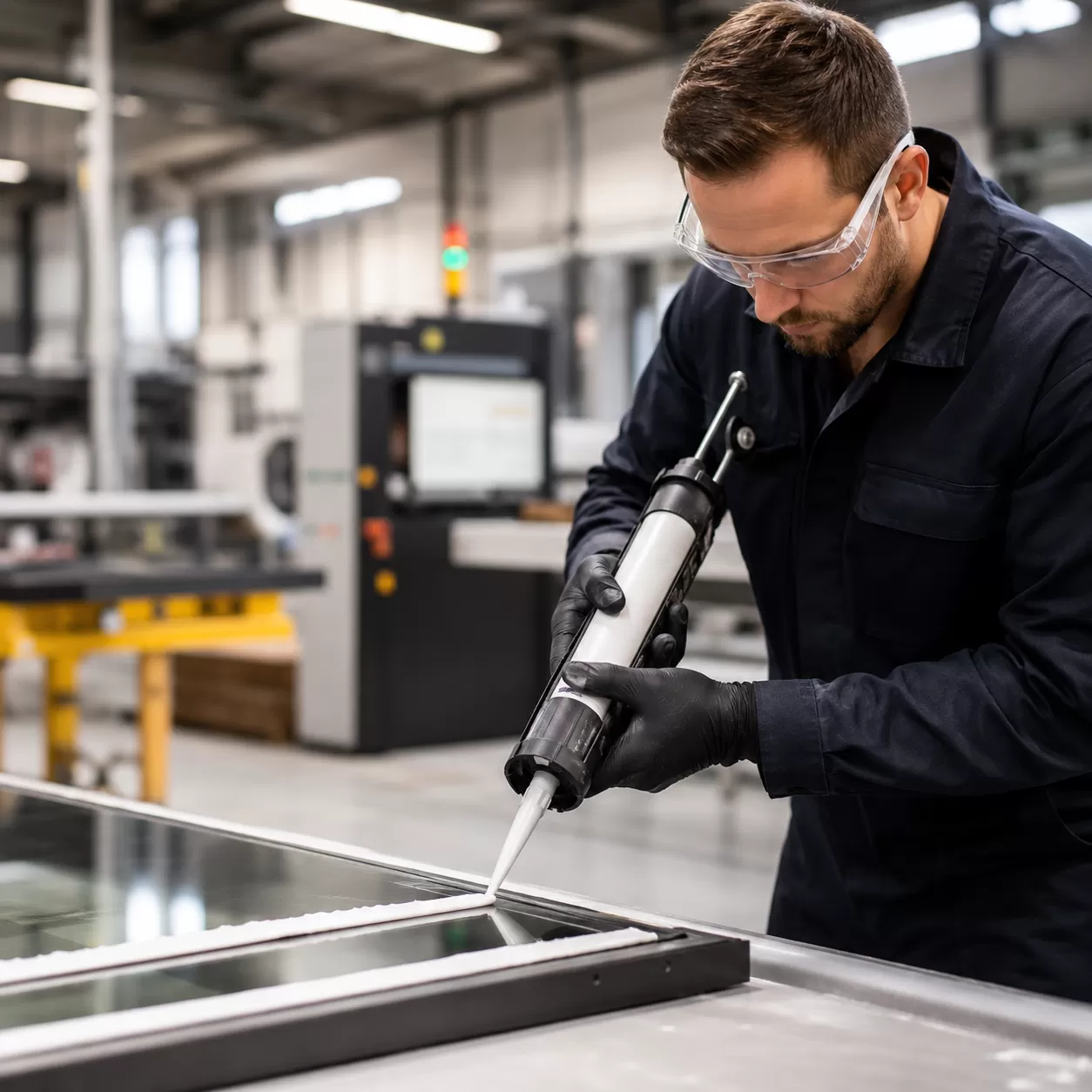
A suitable adhesive can still fail if the production conditions move outside the intended process window.
Surface Preparation
Check for:
- MDF or wood dust;
- oil;
- release contamination;
- plastic processing residues;
- aluminum surface condition;
- primer requirements;
- required surface treatment.
Surface treatment should be based on the actual material combination.
Temperature Management
Relevant zones can include:
| Zone | What to Check |
|---|---|
| Melter / tank | Stable melting without excessive heat history |
| Hose | Consistent transport conditions |
| Applicator | Suitable viscosity at the coating point |
| Profile | Actual surface temperature affecting wet-out |
| Wrapping material | Heat sensitivity and dimensional stability |
Where necessary for troubleshooting, verify important temperatures using an appropriate measurement method rather than relying only on the machine display.
Production Environment
Ambient conditions can affect substrate temperature and reactive PUR curing.
Instead of applying one universal temperature or humidity rule:
- follow the grade-specific TDS;
- record seasonal variation;
- consider material storage conditions;
- allow the specified conditioning time;
- confirm final performance through end-use testing.
Equipment Maintenance
Follow the adhesive and equipment suppliers’ procedures for:
- purging;
- cleaning;
- shutdown;
- filter replacement;
- storage;
- moisture protection;
- prevention of excessive heat exposure.
Do not assume that standard EVA is automatically suitable for flushing a PUR system unless that procedure is approved by the relevant suppliers.
Before Changing Adhesive, Record Your Current Production Window
Before testing another grade, record the current line conditions.
At minimum, capture:
- core substrate;
- wrapping material;
- current adhesive;
- surface treatment;
- application method;
- adhesive temperature settings;
- line speed;
- application-to-contact timing;
- approximate consumption or coat weight;
- current defect or limitation.
These details make supplier recommendations much more useful than a general request such as:
“We need a stronger PUR glue.”
When Should You Consider Changing Your Current Profile Wrapping Adhesive?
A new adhesive grade may be worth testing when you have a repeatable production or finished-product problem such as:
- recurring edge lifting;
- insufficient usable open time;
- poor adhesion after changing substrate or foil;
- unstable coating behavior;
- excessive char or cleaning downtime;
- failure in required heat, moisture, or aging tests;
- a new production-speed target;
- a customer requirement that the current adhesive cannot meet.
However, changing adhesive simply because another grade has a lower price per kilogram may not reduce total cost.
If the current adhesive:
- runs consistently;
- has acceptable consumption;
- produces a low reject rate;
- passes the required finished-product tests,
then a chemistry change should have a clear technical or commercial objective before production trials begin.
Which Adhesive Should You Test First?
Use this simplified screening logic.
Demanding heat, moisture, or environmental exposure?
→ Start by evaluating a suitable PUR grade.
Moderate interior application with an established thermoplastic line?
→ Compare appropriate EVA, PO, and PUR grades under the same conditions.
Difficult plastic or coated surface?
→ Check surface preparation first, then evaluate grades designed for that interface.
Tight radius or stiff decorative material?
→ Prioritize both usable open time and green strength.
Edge lifting appears only when the line runs faster?
→ First investigate coating-to-contact timing, substrate temperature, adhesive transfer, and pressure before changing chemistry.
Want us to narrow the trial list?
Send KAISUN your substrate, wrapping material, application method, line speed, current adhesive, and current problem.
These six inputs are usually enough for an initial adhesive direction.
How to Test a Profile Wrapping Adhesive Before Bulk Purchase
Do not approve a candidate grade from a TDS alone.
A hot melt adhesive TDS, SDS and COA provides important product and documentation information, but application suitability still needs to be verified using the real production materials.
Step 1: Establish the Baseline
Run the current adhesive under normal conditions.
Record:
- speed;
- consumption or coat weight;
- temperatures;
- material lot;
- visible defects;
- accepted output.
Step 2: Start With Supplier-Recommended Conditions
Avoid changing multiple variables at the same time.
Begin close to the documented starting conditions for the candidate grade.
Step 3: Check Immediate Wrapping Quality
Inspect:
- foil alignment;
- edge lifting;
- corner retention;
- bubbles;
- visible coating marks;
- squeeze-out;
- handling stability.
Step 4: Challenge the Process Window
Where relevant, test:
- normal production speed;
- planned higher speed;
- stops and restarts;
- expected substrate-temperature variation.
Step 5: Allow Appropriate Conditioning
For reactive PUR, allow the agreed cure or conditioning period before evaluating final performance.
Do not compare a freshly produced PUR assembly directly with a thermoplastic system if the evaluation timing does not reflect their different bonding mechanisms.
Step 6: Perform Finished-Product Tests
Depending on the application, testing may include:
- peel or delamination checks;
- heat exposure;
- cold exposure;
- humidity;
- water exposure;
- thermal cycling;
- aging;
- cleaning-agent exposure;
- dimensional cycling.
Test methods and pass criteria should match the finished product rather than a generic adhesive benchmark.
Common Profile Wrapping Problems and What to Check
| Problem | Possible Causes | First Checks |
|---|---|---|
| Edge lifting | Insufficient green strength, low interface temperature, spring-back | Open time, substrate temperature, coat weight, pressure |
| Delamination after storage | Surface incompatibility, contamination, unsuitable grade | Failure surface, cleaning, treatment, conditioning |
| Adhesive sets before contact | Effective open time too short | Distance, line speed, substrate temperature |
| Foil moves after rollers | Low initial strength or insufficient pressure | Adhesive behavior, roller setup, application level |
| Visible adhesive pattern | Excess or uneven coating | Coat weight, transfer, viscosity |
| Poor adhesion to plastic | Low surface energy or incompatible formulation | Treatment, contamination, grade compatibility |
| Poor adhesion to aluminum | Rapid cooling or surface-preparation issue | Profile temperature, cleaning, primer, open time |
| Bubbles | Trapped air, irregular coating, contamination | Coating uniformity, pressure path, surface cleanliness |
| Char or gel | Excessive heat history or contamination | Temperature, residence time, shutdown procedures |
| Frequent applicator contamination | Degradation or foreign material | Filtration, temperature stability, handling |
Do not automatically increase application temperature whenever a problem appears.
Higher temperature may reduce viscosity temporarily, but it can also affect open time, substrate sensitivity, and adhesive heat history.
How to Handle PUR Profile Wrapping Adhesive Correctly
PUR requires more process discipline than conventional thermoplastic hot melts.
Because reactive PUR is moisture-sensitive before application, follow the specific adhesive and equipment instructions for:
- storage;
- opening containers;
- melter loading;
- moisture protection;
- shutdown;
- cleaning;
- purging;
- disposal.
Do not assume that a conventional EVA adhesive can be used as a PUR flushing material.
Use only the cleaning or purge procedure approved for the adhesive and equipment system.
The same principle applies to cure conditions.
There is no universal humidity or curing-time value that should be copied across every PUR profile-wrapping process.
Follow the grade-specific information and confirm finished-bond performance after suitable conditioning.
Compare Cost per Accepted Profile, Not Adhesive Price per Kilogram
Purchasing decisions should consider more than adhesive price.
A more useful comparison is:
Cost per accepted profile = adhesive consumption + startup waste + cleaning cost + rejected-part cost + downtime impact
A more expensive adhesive can still reduce total manufacturing cost if the validated process:
- lowers reject rates;
- reduces stable coat weight;
- decreases cleaning interruptions;
- improves first-pass yield;
- eliminates recurring delamination.
Likewise, changing to a technically more advanced adhesive does not automatically reduce cost if it adds unnecessary equipment or process complexity.
Use production data rather than chemistry assumptions.
What Information Should You Send With a Profile Wrapping Adhesive RFQ?
You do not need a complete laboratory report before contacting a supplier.
Minimum Information for an Initial Recommendation
Send these six items first:
- Core substrate — MDF, PVC, WPC, aluminum, wood, or other material.
- Wrapping material — PVC film, PET, PP, CPL, veneer, decorative paper, or other facing.
- Application method — roller, slot die, or other system.
- Line speed.
- Current adhesive, if available.
- Current problem or performance target.
This information is normally enough to begin screening suitable grades.
Additional Information That Improves the Recommendation
Where available, also provide:
- substrate supplier or grade;
- wrapping-material supplier or grade;
- surface treatment or primer;
- profile drawing or photo;
- tightest radius;
- melter or drum equipment;
- tank, hose, and applicator temperatures;
- profile temperature;
- application-to-contact time;
- current coat weight or consumption;
- end-use environment;
- customer test requirements;
- expected annual consumption;
- preferred sample quantity;
- production trial schedule.
You can also use our complete hot melt adhesive RFQ checklist when preparing a formal enquiry.
Profile Wrapping Adhesive FAQ
What is the best adhesive for profile wrapping?
There is no universal best profile wrapping adhesive.
PUR is frequently evaluated for applications with demanding heat, moisture, or durability requirements. EVA and polyolefin can remain suitable for other materials and production conditions.
The best grade is the one that fits the real materials, equipment, processing window, and required finished-product tests.
Is PUR always better than EVA for profile wrapping?
No.
PUR can provide advantages in demanding applications, but it also requires suitable equipment, storage, handling, and process control.
If an EVA grade already runs consistently and meets the required finished-profile performance, changing to PUR should have a clear technical or commercial reason.
Can PUR be used for PVC profile wrapping?
Yes. Suitable PUR hot melts are widely used in PVC profile-wrapping applications.
However, PVC formulation, wrapping film, pretreatment, profile temperature, and adhesive grade can all affect the result.
Test the actual production materials.
Can profile wrapping adhesive bond aluminum?
Yes.
Suitable adhesive systems are used for aluminum profile wrapping, but aluminum’s high thermal conductivity can shorten the effective bonding window.
Cleaning, pretreatment, profile temperature, adhesive open time, and pressure timing should be evaluated.
How do I prevent edge lifting?
Check the full process rather than changing adhesive immediately.
Important variables include:
- wrapping-material stiffness;
- profile radius;
- adhesive wet-out;
- open time;
- green strength;
- substrate temperature;
- coat weight;
- pressure-roller setup;
- surface preparation.
If the materials are fundamentally incompatible, simply increasing adhesive quantity or temperature will not solve the problem.
What line speed should I use?
There is no universal production speed for PUR, EVA, or polyolefin profile wrapping adhesive.
The usable speed depends on:
- adhesive grade;
- coating method;
- profile geometry;
- coating-to-contact distance;
- substrate temperature;
- wrapping material.
Determine the stable production window through controlled trials.
What coat weight should I use?
Start with the range recommended for the specific grade and application.
Then verify actual consumption, wrapping quality, and finished-bond performance on the production line.
A generic g/m² value from another profile-wrapping process should not be treated as a project specification.
Choose the Adhesive From the Real Profile Wrapping Process
A reliable hot melt adhesive for profile wrapping should be selected using the complete production system:
core substrate → wrapping material → surface preparation → application equipment → line timing → profile geometry → finished-product test
PUR may be the right starting point for demanding profile-wrapping projects.
For other applications, EVA or polyolefin may provide the required performance with a simpler or more economical process.
The final decision should be based on the actual production line and finished-profile requirements.
Request a Profile Wrapping Adhesive Recommendation
For the first screening, simply send:
- profile substrate;
- wrapping material;
- application method;
- line speed;
- current adhesive;
- current problem or target.
KAISUN can use these inputs to narrow the adhesive direction, recommend a candidate grade, and arrange a sample for your production trial.


